Leather Key Fob Guide: Styles, Materials and Care
Most advice treats a leather key fob cover as if it solved every problem at once. It doesn't. A good cover can stop scratches, soften a drop, and make a bulky remote easier to hold, but it won't block a radio signal, fix a weak attachment hole, or make poor leather last. If you separate those jobs, choosing becomes simple. Start with fit, then decide how you'll store the fob at home, then check the leather and hardware before you pay for personalization.
Table of Contents
- Leather Key Fob Styles and Which Suits Your Keys
- Why Keyless Remotes Need Covers and What Covers Cannot Stop
- Full-Grain Leather and Hardware That Last
- How to Personalize a Key Fob Without Weakening It
- Caring for Patina, Sweat and Rain
- Choose the Right Cover and Storage Before You Order
Leather Key Fob Styles and Which Suits Your Keys
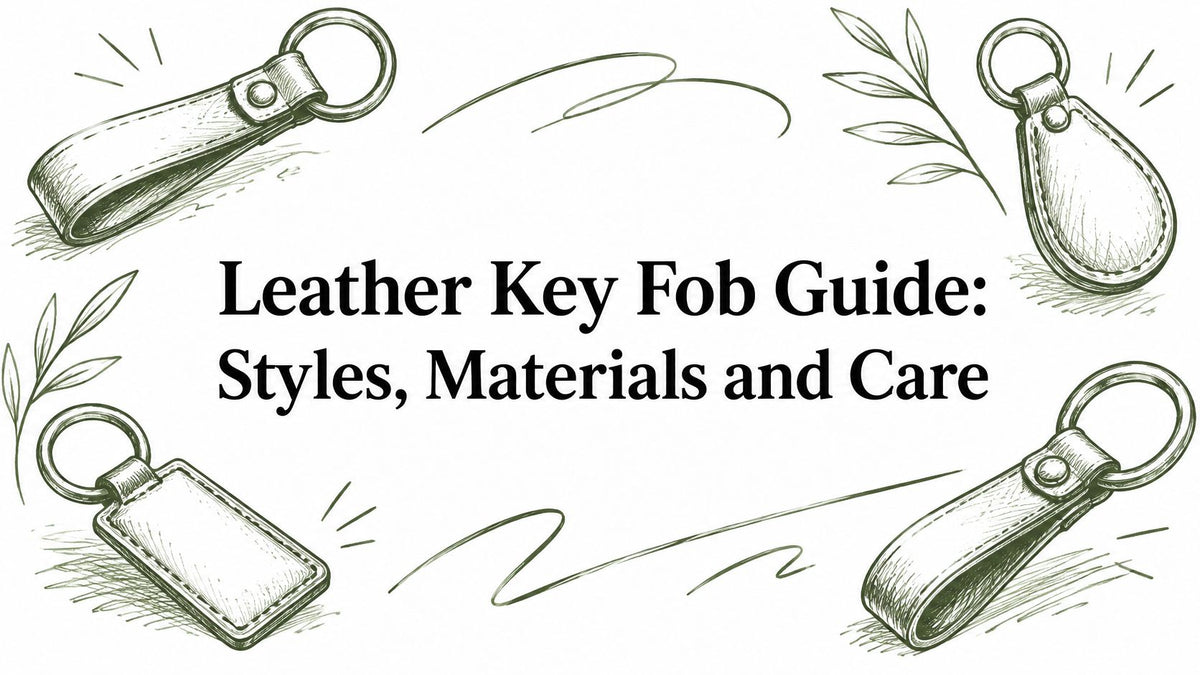
Buyers usually choose between four styles, and the right one depends on what else travels with the remote.
Leather key fob cover styles compared
| Style | Fits | Protection | Trade-off |
|---|---|---|---|
| Slim sleeve | Standard remote with one to two buttons | Light scratch protection | Little room for a metal key |
| Full wrap cover | Large remote or flip-key fob | Covers buttons and edges | Harder to remove; check button access |
| Keyring pouch | Fob plus two or three house keys | Moderate impact cushioning | Bulkier in a pocket |
| Loop strap | Fob carried on a wrist or bag strap | Limited, mainly comfort | Not suited to pocket carry |
How Each Style Works in Practice
A slim sleeve suits a basic two-button remote that rides alone in a pocket. It's the least bulky option, but it leaves little room for a folding metal blade and it won't cushion a hard fall well.
A full wrap cover fits a larger remote or flip key that needs edge and button coverage. You'll gain protection, but removal for a battery change is slower, so check that every button presses cleanly through the leather and the emergency key blade stays reachable.
A keyring pouch holds the fob plus two or three house keys, which stops metal keys from chewing the plastic casing. The cost is bulk. A loop strap works on a wrist or bag strap for quick access, but it offers comfort more than protection and it swings around in a pocket.
Measure Before You Buy
Measure your remote's width, thickness, and height in millimetres with a ruler or calipers, and note whether it has a folding key blade. A cover that's even a few millimetres off will either hide a button or let the fob slide out.
Quick rule: Pick a sleeve for a single slim remote, a full wrap for a flip key, and a pouch when house keys share the same pocket.
If you're matching a cover to other daily carry pieces, our guide to leather accessories for men shows how sizes and finishes work together. Pocket carry favors slim shapes. Bag carry tolerates a pouch.
Why Keyless Remotes Need Covers and What Covers Cannot Stop
A leather cover can help prevent scratches and worn buttons. It cannot, by itself, prevent a keyless car's radio signal from being relayed. Those are separate problems, and the right choice depends on which one you need to address.
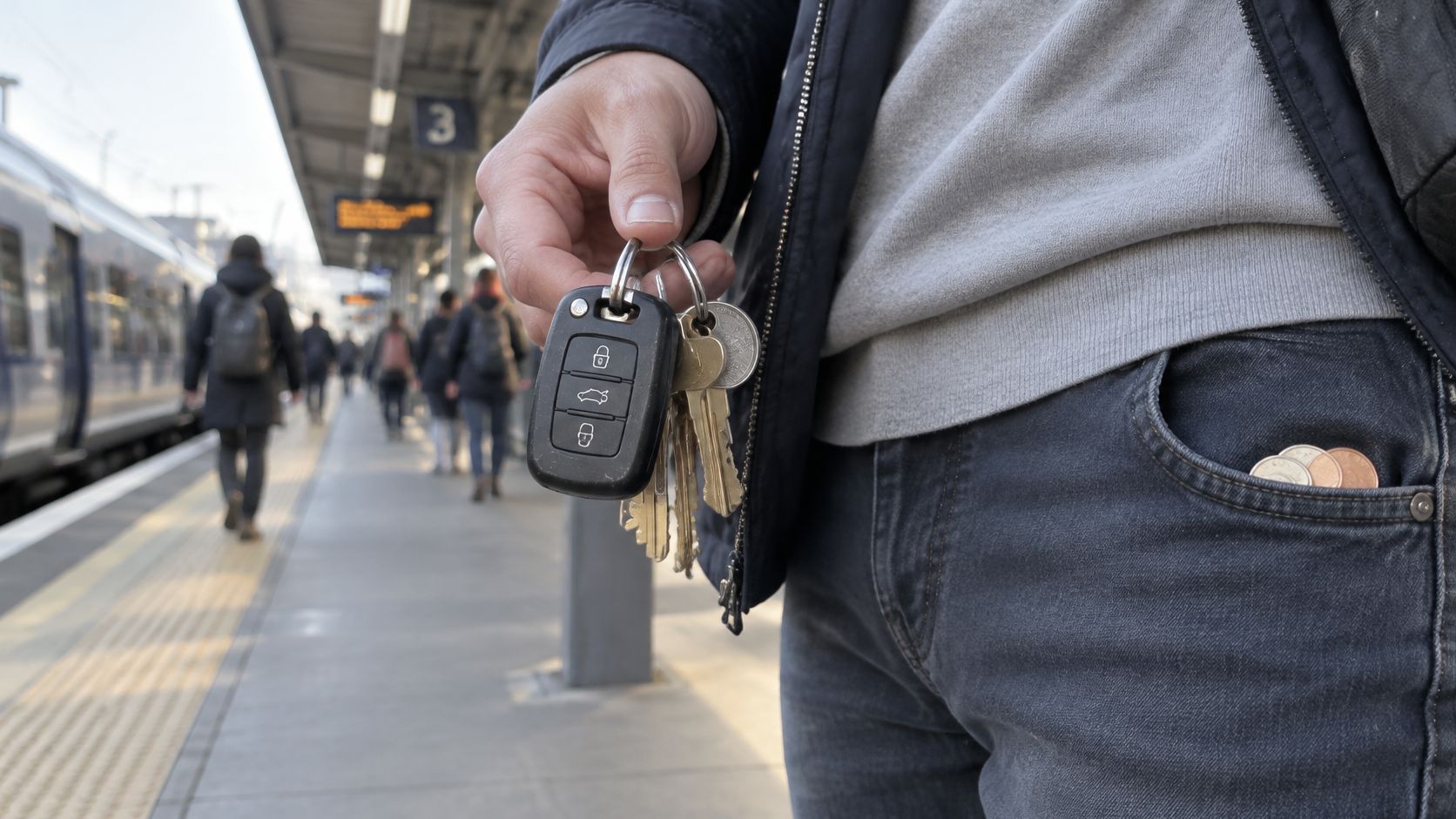
Keyless remotes put electronic controls in the same pocket as coins and keys. Repeated rubbing can mark the casing or wear the button symbols; a drop can crack a corner. A cover acts like a buffer between the fob and those everyday knocks.
What a Cover Does Well
A well-fitted leather key fob cover reduces direct abrasion on the plastic shell and cushions edges that may hit a hard surface in a fall. Leather can also provide a steadier grip, especially when your hands are damp.
A cover can keep loose house keys from scraping the fob's buttons, too. These are practical forms of physical protection. They do not make the remote indestructible, so fit still matters: buttons and any emergency blade need to remain usable.
What It Cannot Do
Ordinary leather does not block the radio signal used by passive-entry systems. A leather cover may look protective while leaving that signal unaffected.
Relay attacks extend communication between a vehicle and its remote. Research on relay attacks against vehicle keyless systems describes how relays can succeed across vehicle models even when strong authentication and encryption are present. In practical terms, equipment can make a car respond as though its fob were close by, even if the fob is inside a home.
RFID protection for cards and protection against automotive keyless relay attacks are different questions. A conventional leather sleeve does not provide Faraday shielding. For a closer explanation of the distinction, see this guide to whether leather blocks RFID.
For another perspective on fit and access for common remotes, consult the Blade Auto Keys fob cover guide. A cover that makes buttons difficult to press may be frustrating in daily use, even if it protects the casing from scuffs.
Run This Signal Test Yourself
Test any pouch, tin, or other storage rather than assuming it blocks the fob's signal.
- Lock the car and put the fob inside the storage, closed as you would leave it at home.
- Stand beside the door handle at your normal distance, holding the storage in your hand or pocket.
- Pull the handle and try the start button if your car allows passive starting.
- If the car opens or starts, that storage has not blocked the signal in this test. Try a shielded pouch or closed metal tin, then repeat the test.
Check the car's handbook and settings for options such as a motion-sensing sleep mode. Availability depends on the vehicle, and signal-blocking pouches can differ in performance.
Repeat the test with each fob, vehicle, and storage option. A result for one combination does not establish how another will behave. Use a leather cover for everyday physical protection, and treat signal-blocking storage as a separate choice.
Full-Grain Leather and Hardware That Last
Most fob failures don't start in the middle of the leather. They start at the split ring, where metal bends, plating wears, and the ring cuts into the attachment hole.
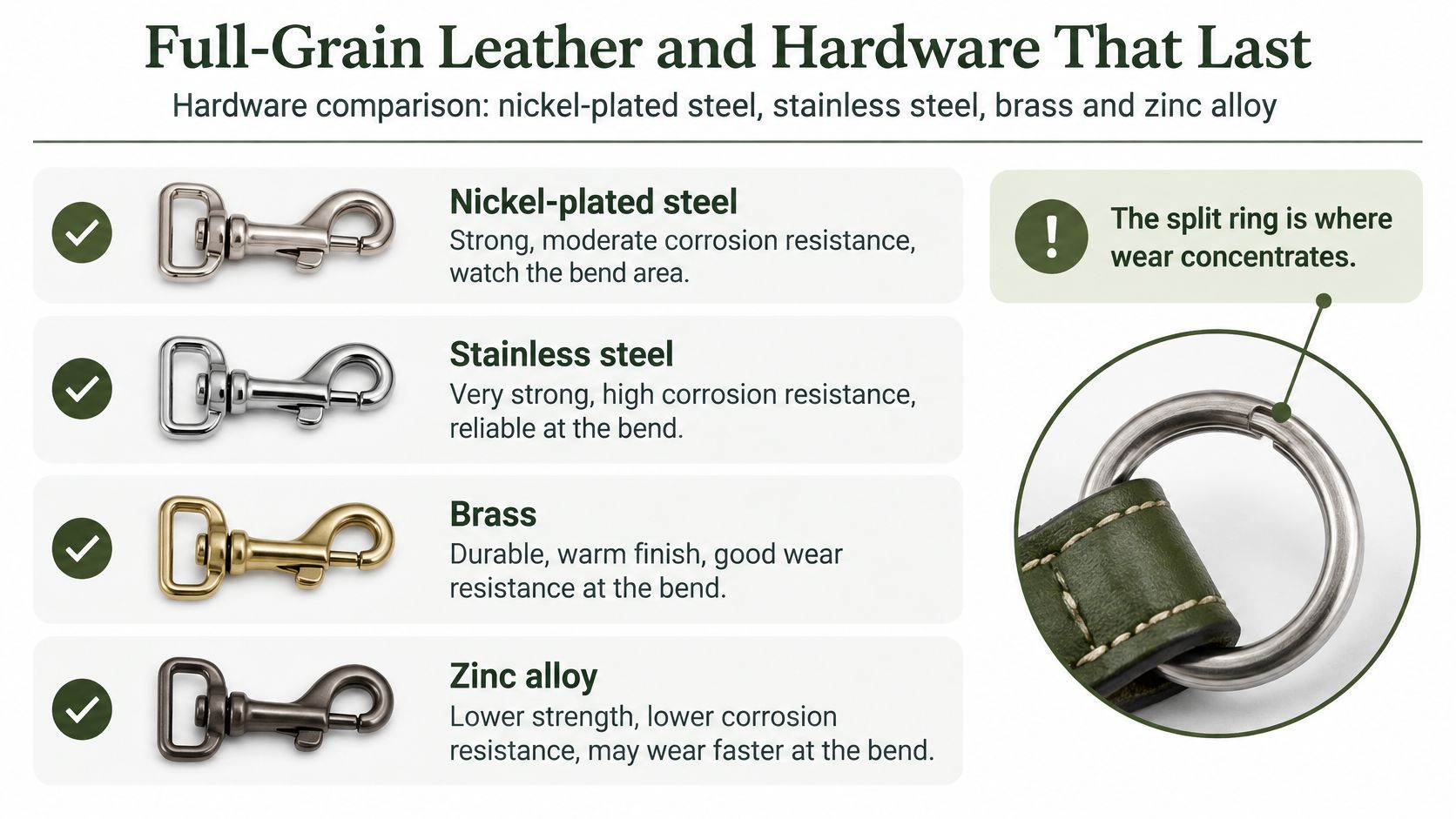
Key fob hardware compared
| Hardware | Strength | Corrosion resistance | Note |
|---|---|---|---|
| Nickel-plated steel split ring | High | Moderate | Common; plating can wear at the bend |
| Stainless steel split ring | High | High | Best choice for daily wet use |
| Brass ring | Medium | Good, develops patina | Softer; can deform under heavy key loads |
| Zinc alloy clasp | Medium | Low | Low cost; can crack under repeated stress |
Stainless steel is the safest pick if your keys get wet often. Nickel-plated steel is strong, but inspect the bend where plating wears first. Brass looks warm and ages well, yet it's softer under a heavy bunch of keys. Zinc alloy clasps keep costs low, but they can crack after repeated stress.
What Full-Grain Actually Means
Full-grain leather keeps the hide's outer grain layer intact. That surface carries the tightest fibres, so it resists scuffs and develops patina instead of peeling. Corrected or genuine leather is sanded and embossed to hide flaws, which removes or covers that strongest layer and leaves a weaker, more uniform surface.
A typical fob cover uses leather roughly 1.2 to 2.0 mm thick. Thicker wraps cushion impact better but add bulk and can dull button feel, so thinner isn't automatically worse. What matters is the grain quality of the specific piece in your hand, not the size of the global raw-hide supply behind it. Our explainer on grades of leather breaks down how those labels differ.
A Five-Point Buyer Checklist
- Intact grain: The outside face shows natural pore pattern, not a plastic-looking emboss.
- Burnished edges: Edges feel smooth and sealed rather than raw and fuzzy.
- Even stitching: Stitches sit close, straight, and at a consistent distance from the edge.
- Flat rivets or washers: Hardware sits flush without rocking or sharp rims.
- Clean ring closure: The split ring opens for keys and closes without a visible gap.
How to Personalize a Key Fob Without Weakening It
Personalization fails when decoration lands on a stress point. The attachment hole carries every swing and snag from your keys, so protect that zone first and place letters second.
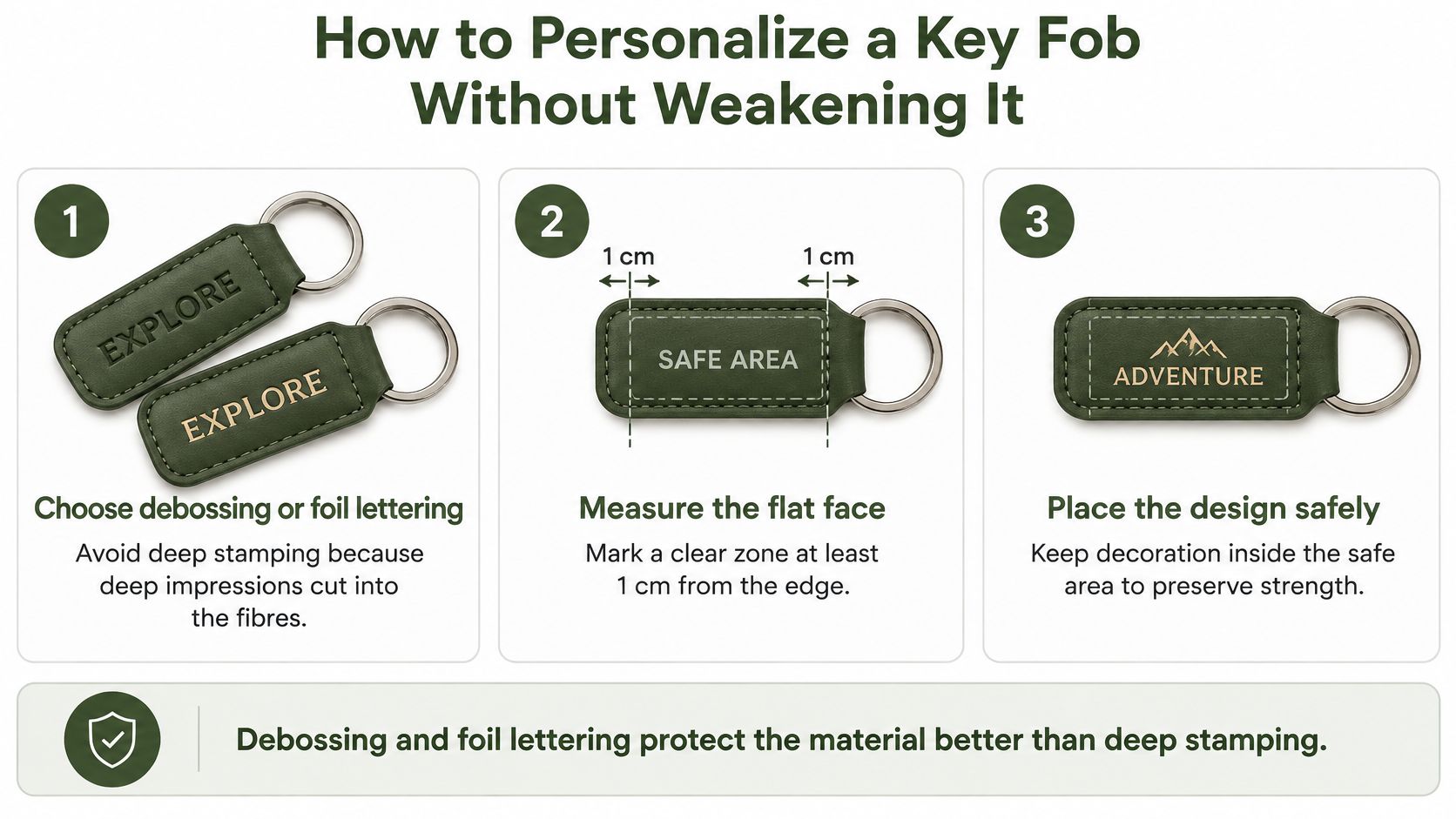
Six Steps That Keep the Leather Strong
- Choose debossing or foil lettering rather than deep stamping, because deep impressions cut into the fibres and can start cracks.
- Measure the flat face and mark a clear zone at least 1 cm from the attachment hole and from every edge.
- Place initials opposite the buttons, on the flat face, so thumbs and keys don't rub the lettering away.
- Avoid internal corners and stitch lines, since those areas already concentrate stress.
- Test on an offcut of the same leather first, checking that letters stay sharp and the grain doesn't crack or pucker.
- Confirm the reinforcement, asking whether the attachment point uses a folded leather return, washer, or stitched tab to spread the ring's load.
That reinforcement matters for a clear reason. Research on leather mechanics in Springer explains that ASTM D2212 defines slit-tear resistance and ISO 3377-1 measures single-edge tear load, and both are relevant because a split ring concentrates force at a small punched opening. Tear resistance around that hole, not bulk tensile strength, is usually the failure-critical property.
The common slip is stamping close to the hole because the space looks empty. That turns a personal touch into the place where the leather tears first. For examples of safe placement and depth, see our guide to an embossed leather logo.
A good result is easy to spot. The letters look crisp, the hole stays round and undisturbed, and the edge still feels smooth when you run a fingertip around it.
Caring for Patina, Sweat and Rain
Sweat, rain and pocket grit affect a leather key fob differently. Grit can scuff the surface, while excess moisture can leave leather stiff or discoloured as it dries. A simple routine keeps daily wear manageable without over-treating the leather.
Typical care by climate and use
| Climate or use | Conditioning | Cleaning | Typical frequency |
|---|---|---|---|
| Humid or rainy region | Apply a light coat of wax only after the fob is fully dry | Wipe with a damp cloth, then air dry at room temperature | Every three to four months |
| Dry climate | Apply conditioner sparingly | Dust with a soft cloth | Every two to three months |
| Daily commuter with keys | Apply a light coat to the flat face | Wipe weekly to remove grit | Every four to six months |
| Outdoor or sports use | Condition after the fob has fully dried from soaking | Rinse, then air dry at room temperature | After each soaking |
The Basic Routine
Wipe the fob with a soft, dry or barely damp cloth to remove grit before it rubs against the grain. If the leather gets soaked, let it air dry at room temperature. Avoid using heat: rapid drying can stress the leather.
Use conditioner sparingly. Too much can leave a small, frequently handled fob greasy and more likely to collect grit; too little care in dry conditions can leave leather brittle. Apply a thin coat, let it absorb, then buff away the excess. This guide to conditioning leather explains how to apply conditioner to small leather goods.
Patina Versus Damage
Patina is the gradual darkening and smoothing caused by hand oils and friction. A fob that darkens where your thumb rests is showing normal wear; cracks near the ring point to a weakened attachment area.
Replace the fob rather than trying to restore it if you notice:
- Cracks running from the attachment hole toward the edge
- A stretched or torn hole that lets the ring move sideways
- Loose rivets or a bent ring that no longer closes cleanly
- Peeling edges that expose fuzzy fibres underneath
Choose the Right Cover and Storage Before You Order
Use a decision rule, not a guess, when you combine a daily cover with home storage.
For daily pocket carry, choose a slim sleeve, full wrap, or pouch based on fit alone when your car uses a mechanical key or has no passive entry. In that case, signal blocking isn't part of the decision and you can prioritize grip, button feel, and bulk.
If your car uses passive entry and your test accessed the car with the fob in its proposed storage, keep the fob in a shielded tin or pouch at home. Your leather cover can stay on the fob inside that storage. You're solving two different problems with two different items, and that's fine.
Don't order storage on trust. If the car unlocks during your test, that storage has failed for your fob, whatever the label claims.
Run the test again after any change of car, fob, pouch, or tin. A pouch that blocks one fob may not block another, and worn shielding material can lose effectiveness where it folds.
Set Personalization Before You Pay
Confirm the stamping zone sits at least 1 cm from the attachment hole and from every edge, on the flat face opposite the buttons. Agree the exact initials, foil colour if you're using foil, and letter size before work starts, because debossing can't be undone. The website has a section for Personalised Leather Gifts, which helps if the fob is part of a matched gift rather than a solo purchase.
Order in This Sequence
- Measure the fob in millimetres, including thickness and any folding blade.
- Match it to a style using the first comparison table.
- Check grain and hardware against the five-point checklist.
- Confirm the personalization zone and reinforcement at the hole.
- Place the order only once your signal test has passed, or you've confirmed the car doesn't use passive entry.
That order prevents the usual mistake. Buyers often pick a colour first, discover the blade won't fold, then learn their bedside drawer doesn't block anything. Measure, test, then decorate.
Browse full-grain small leather goods and key storage at Grainmark Leather, where you'll find daily carry pieces built around intact grain, solid hardware, and honest construction. Pick your cover by measured fit first, then add personalization in a safe zone for a fob that ages well and stays secure at home.