Leather Briefcase Bag Mens Guide for Work
Buy the most formal briefcase you can afford and make it work every day. That's the popular advice, and it's often wrong. A rigid case that photographs well at a client table can punish you on a train platform, refuse to fit under a seat, and hang its laptop weight a few inches too far from your body. Choose a leather briefcase bag for men's work the other way around. Start with your heaviest regular day, your commute, and your measured laptop, then let the hide and hardware earn their place.
Table of Contents
- Leather Briefcase Styles for Real Workdays
- Full-Grain Strength Behind a Work Bag
- Laptop and Paper Sizes That Fit
- How Briefcase Weight Sits on the Body
- Care Repairs and Years of Use
- Three Workdays and Your Next Briefcase
Leather Briefcase Styles for Real Workdays
The most formal bag is not automatically the best daily carry. An attaché keeps contracts flat and looks composed in a boardroom, but its hard shell can be awkward on a long walk, a crowded tram, or a bike ride to the station. Choose only for the meeting and the shape may frustrate you for the rest of the day.
Hybrid schedules have blurred the old office routine. In the JLL Workforce Preference Barometer, 66% of global office workers reported in 2025 that their employers set clear expectations for the number of days spent on-site. For a hybrid workday, one bag may need to move between a home desk, office, client site, and public transit without requiring you to repack. That makes the right silhouette a question of how you carry and access your things, not just how formal the bag looks.
Four Silhouettes That Solve Different Problems
An attaché is a rigid box with a top handle and often a lock. It keeps files flat between a desk and a client table, and its closure can help keep papers contained. The trade-off is comfort in motion: hard corners are unforgiving in a tight footwell, and the top handle is less convenient on a longer walk.
A messenger has a flap and shoulder strap, making a charger, notebook, or papers easier to reach on a train without setting the bag down. Its softer outline reads less formally. Compare the leather briefcase and messenger bag styles by how you travel and work, rather than by appearance alone.
A portfolio is a slim case for flat paper, a notebook, and a pen. It suits a document-light office day and slides easily beside a chair, but it is a poor choice for a heavy laptop. If you have to bow the sides to close it around a computer, the zipper, corners, and lining will take the strain.
A convertible briefcase combines a handle with a padded shoulder strap, and sometimes a backpack mode. That flexibility can suit a hybrid week: carry it by hand into a meeting, then put it over your shoulder for the station walk. A backpack mode can also spread the load when the day involves more walking.
Men's Leather Briefcase Styles by Workday
| Style | Structure | Typical load | Best workday |
|---|---|---|---|
| Attache | Rigid box, top handle, often a lock | Flat files plus a thin laptop | Court, client table, short walks |
| Messenger | Flap closure and shoulder strap | Laptop, charger, papers grabbed in transit | Train or longer commute |
| Portfolio | Slim folder, little padding | A4 or letter sheets, notebook, pen | Document-light office day |
| Convertible briefcase | Handle plus padded strap or backpack mode | Laptop, papers and charger, carried by strap on the walk | Hybrid week or longer commute |
Start with the row that matches your normal load. Then check details that product photos may not show: Is the laptop compartment padded for daily transit? Does the bag stand upright beside a desk? Will it fit under an airplane seat? When you remove the strap, does its hardware sit comfortably against your fingers?
Buy for the heaviest regular day, not the rare overnight trip. An oversized bag that's half empty four days a week adds weight and sway.
Choose the smallest silhouette that carries your ordinary heavy day without forcing its closure or bending files. Keep clothes in a separate duffel. This keeps the briefcase focused on work and reduces the temptation to overpack it. A formal shell can still be the wrong daily bag if its shape, access, or carrying options do not suit your route.
Full-Grain Strength Behind a Work Bag
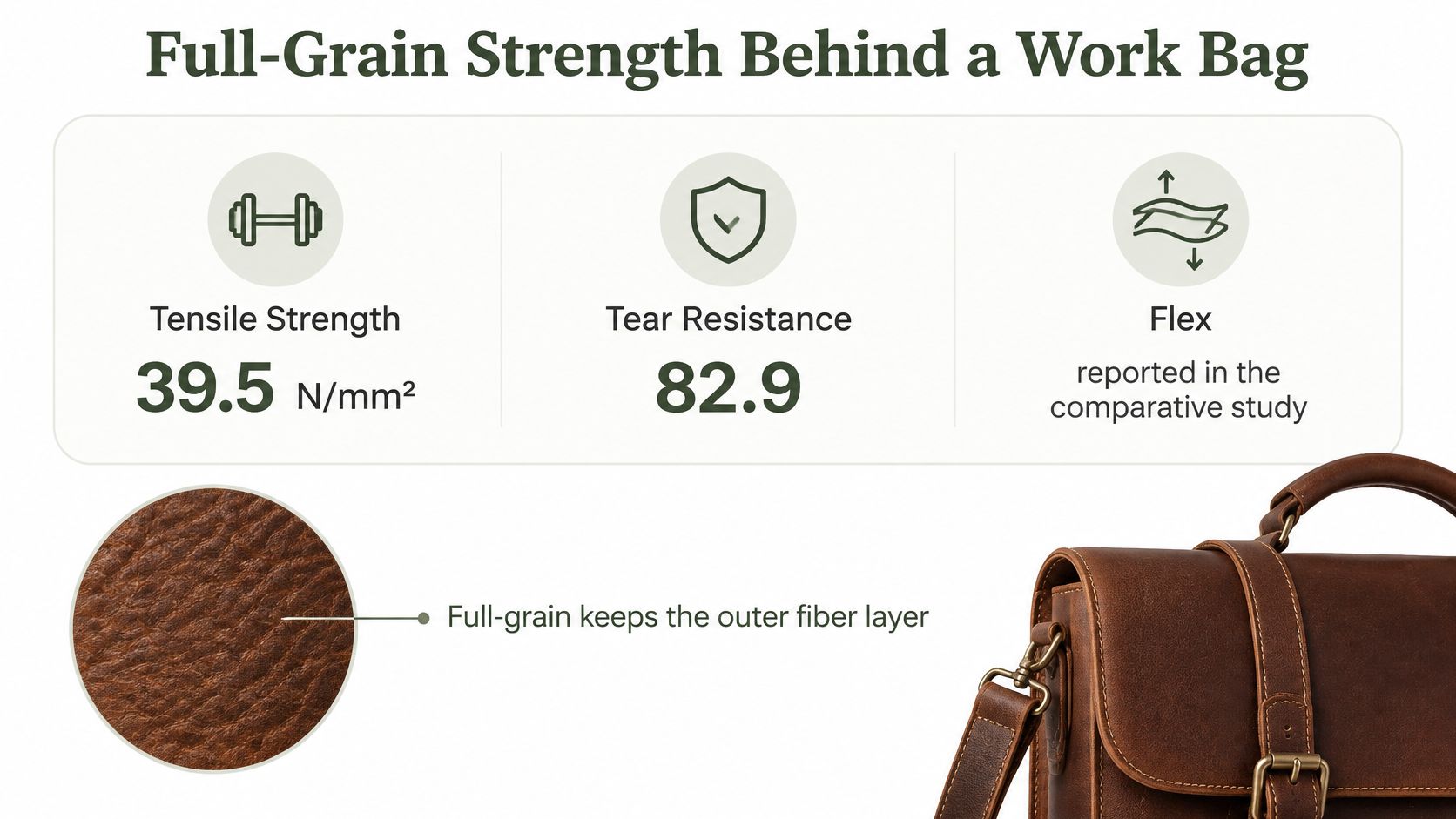
Full-grain leather keeps the hide's outer fiber layer intact. That is the point. It's not a luxury sticker, and it shouldn't be treated as proof that the whole bag is well made. Judged on mechanical performance, a comparative technical study in Coatings reported leather tensile strength of 39.5 N/mm², tear resistance of 82.9, and flex resistance exceeding 200,000 cycles, and it described tensile and tear strength as key advantages of leather over several artificial alternatives.
Where Those Numbers Matter on a Briefcase
Tensile strength matters every time the full load pulls on a handle. Tear resistance matters at strap anchors, seams, folded corners, and the stitch holes around hardware, where a small split can travel under repeated stress. A bag can look thick and still fail there if the load ends at one glued tab or a short row of stitching.
Flex resistance is the quieter requirement. Your briefcase bends under a desk, gets wedged into a vehicle footwell, and flexes in an overhead compartment. The grain at those fold points has to keep moving without cracking open. Corrected or heavily sanded leather may look smoother in the shop, but once the original grain layer has been sanded away or embossed, its wear behavior doesn't match full-grain.
Abrasion is a separate question from strength. Desk edges, suit cloth, luggage shells, seat belts, and hand oils can polish, darken, or scratch a finish while the leather underneath remains structurally sound. Crazy Horse leather and other waxed full-grain cowhides show lighter streaks where wax shifts after a knock. That's surface change, not a torn fiber, and it often tones down with handling.
Four Specification Lines Worth Reading
The word premium tells you nothing. Look for concrete construction instead, and understand the vocabulary before you compare hides using a plain guide to the grades of leather. A credible product page should let you check these points without guessing.
- Leather type: Confirm whether the listing says full-grain, top-grain, or corrected cowhide, because cowhide is a broad label, not a grade.
- Thickness: Check the stated hide thickness and look for reinforcement where handles and strap anchors carry the load.
- Handle attachment: Choose handles stitched through an internal stay or reinforcement panel, so the stress spreads instead of pulling on one small tab.
- Hardware and edges: Inspect solid-feeling hardware, even stitching, and edge paint or burnish that isn't already lifting or cracking.
Don't confuse a heavy shell with a strong system. If hardware loads pass through internal reinforcement, stitching is dense and even, and corners are properly finished, the hide can do the job those lab figures suggest it's capable of doing. If those details are missing, a full-grain label won't rescue the bag.
Laptop and Paper Sizes That Fit
Measure the laptop body before you shop. A screen diagonal is a category label, not a sleeve size, and it doesn't tell you the width, height, or thickness of the chassis. Use a ruler in centimeters, include any hard case you normally carry, and match all three dimensions to the compartment.
Laptop, Paper and Cabin Sizes for a Briefcase
| Item | What the bag needs | Where it fails |
|---|---|---|
| 13-inch laptop | A sleeve opening about 32 to 33 cm wide with clearance for the chassis height and thickness | Sleeve tighter than the chassis |
| 14-inch laptop | A sleeve opening about 33 to 34 cm wide with padding on the back panel | Front pocket with no padding |
| 16-inch laptop | Confirm depth, not just diagonal | Sleeve sized by diagonal, too shallow |
| A4 documents | Flat file pocket | Portfolio with only a writing pad |
| US Letter | Same wide file pocket | Pocket cut only for a narrow notebook |
| Personal item | A body near 40 by 30 by 15 cm that can fit the under-seat space | Rigid attache too deep for the seat |
For a common 15.6-inch laptop, plan for about 38 to 39 cm wide by 26 to 27 cm tall, then leave depth for the charger brick beside the machine rather than pressing it against the screen. A 16-inch laptop may be similar in width but thicker, so a sleeve labeled for a 15.6-inch model can fail on depth even when the diagonal sounds close.
Paper Is Easier Than Sellers Make It Sound
A4 paper is 21.0 by 29.7 cm. US Letter is 21.6 by 27.9 cm. A file pocket that takes A4 flat will usually take Letter, because A4 asks for more height while Letter asks for a little more width. Hold the folder against the pocket mentally before you buy. If a contract stack has to be curled, angled, or forced under a zipper, it's the wrong bag.
A portfolio designed around a writing pad won't suddenly become a proper file carrier because the leather is strong. The shape controls the load. If you need a slimmer document-only option, compare your paper and tablet measurements against a purpose-built laptop document holder rather than asking a padfolio to absorb a full workday.
Depth Is the Size People Forget
Depth decides whether the bag slides under a seat, stands neatly beside your feet, and keeps the laptop close to your body. Many airlines treat a personal item as roughly 40 by 30 by 15 cm, but hard corners and a rigid frame can miss the usable space even when the laptop fits inside. Soft structure can compress slightly. A stiff attaché cannot negotiate.
Put the padded sleeve on the back panel, close to your body, not in a front pocket where the heaviest object swings outward. Aim for roughly 1 to 2 cm of foam wall so a laptop corner doesn't print through the leather or take every knock against a desk. The closure should clear the top edge without dragging across it.
Before you pay, match one table row using width, height, and depth. If the listing only gives a diagonal, keep looking or ask for the internal sleeve dimensions. A leather briefcase bag for men's daily work shouldn't require you to gamble on the machine you carry most.
How Briefcase Weight Sits on the Body
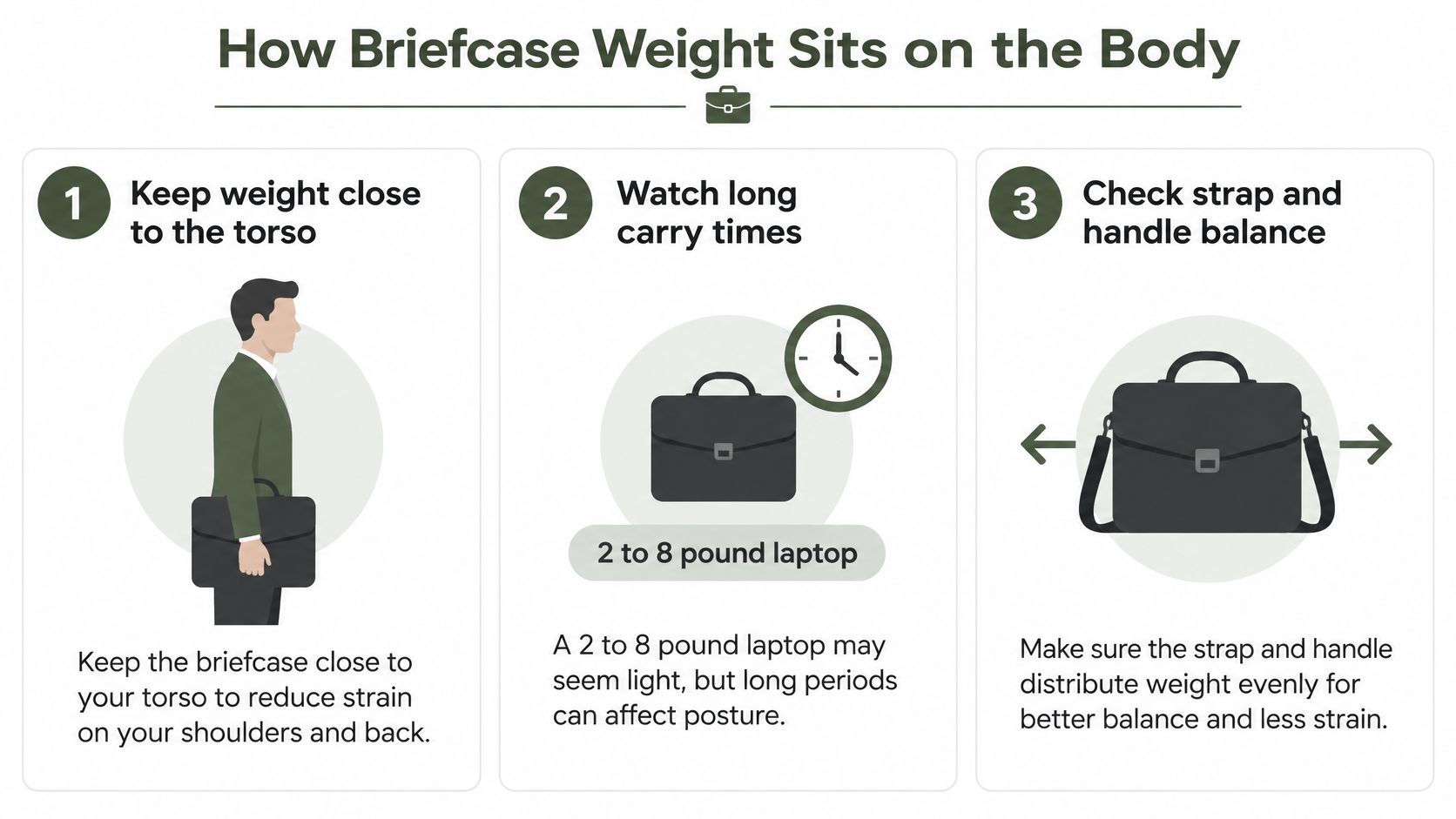
A formal leather shell can still be the wrong daily bag if its load pulls away from your torso. The laptop is often the heaviest item, so its position affects how the briefcase carries during an office day, a transit commute, and a walk between meetings. Balance matters more than choosing the largest bag.
The New Hampshire state risk-management ergonomics guidance notes that prolonged carrying of a 2–8 pound laptop can affect posture. For a bag that isn't wheeled, it advises balancing the load on both sides of the body, using a padded shoulder strap, and switching shoulders frequently.
Turn the Ergonomics Into Features You Can Test
Place the padded laptop compartment against the back panel, closest to your body. That keeps the heaviest item from sitting in an outer pocket, where it can pull the bag away from you. Store files in front of the laptop and small items where they won't collect in one corner.
Check the handle as well as the strap. It should let the case hang beside your leg without twisting your wrist into an awkward angle. A stable base helps when you set the bag down at a ticket gate or beside a café table, so you don't have to hold it one-handed while reaching for something.
A detachable, padded shoulder strap helps on the walk between station and office. Test the clips and rings with the strap removed: hardware that presses into your palm or rolls under your fingers can make hand carry uncomfortable. If you switch between carrying modes during the week, a leather briefcase backpack offers a way to carry the same work kit on your back.
Keep Organization Short and Useful
A useful interior needs one padded device sleeve, one flat file area, one zip pocket for a charger and keys, and pen slots that hold pens without crushing the nibs. Cotton or polyester lining should let a laptop slide in without catching on loose threads.
Organize by weight first and convenience second. Keep heavy items close to your back, flat items in the middle, and small items where they can't drift into a corner.
Use this five-point try-on before choosing a bag:
- Lift it loaded: Put in your laptop, charger, and usual files.
- Walk twenty steps: Notice whether the bag swings away from your leg or pulls one shoulder down.
- Switch shoulders: Check that the strap adjusts readily and stays padded on either shoulder.
- Set it upright: It should stand without tipping or letting the contents spill out.
- Open the file pocket one-handed: Papers should be easy to reach without wrestling the bag.
For a longer commute, alternate between the handle and shoulder strap. If the design supports backpack carry, use it when that suits the route. The right arrangement depends on the whole workday: a bag that feels balanced at a desk can still be awkward on a crowded train or during a longer walk. Check the loaded fit in the carry modes you use.
Care Repairs and Years of Use
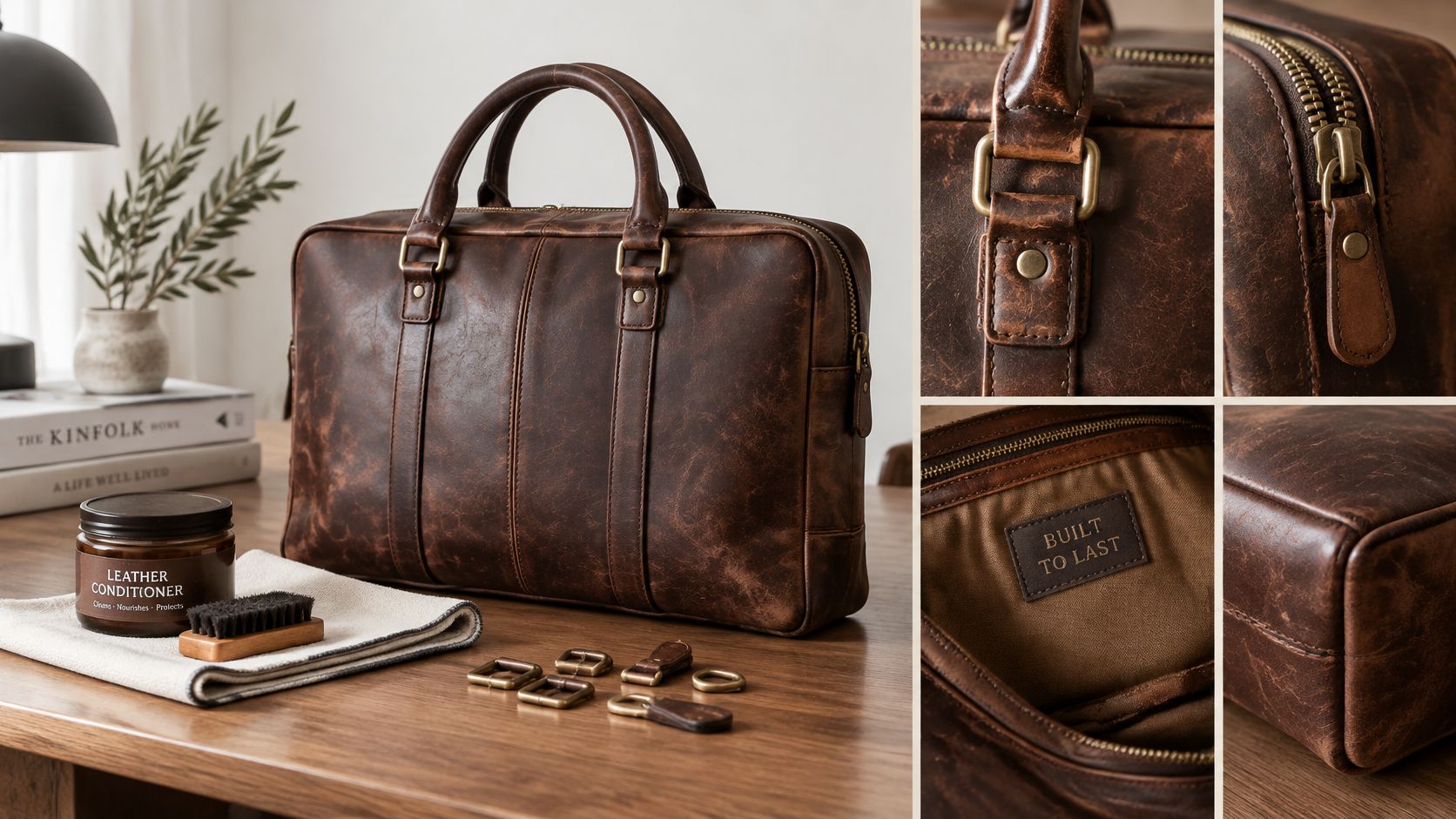
Full-grain isn't a maintenance plan. A light scratch that only shifts wax is patina. A cut through the grain, stitches pulling away from a handle, or a corner that stays soft after rain is structural damage. Confusing those two either makes you baby a harmless mark or ignore a failure until repair becomes replacement.
Longevity sits in the whole system around the hide. Check stitch density, edge finishing, handle attachment, zipper and buckle replaceability, lining durability, base protection, and whether the maker can restitch the bag. The Stand.earth 2025 fashion sustainability scorecard emphasized longer-lasting products that can be repaired, reused, and recycled, which is a useful reminder that natural leather isn't automatically the lowest-impact choice. Durability counts only if the product stays in service.
Leather Briefcase Care by Climate
| Climate | Care routine | Warning sign |
|---|---|---|
| Rainy | Wipe with a barely damp cloth the same day, dry at room temperature, stuffed | Salt or water marks, soft corner |
| Humid | Air the bag out and keep the lining dry | Mildew smell in the lining |
| Dry cold | Condition a little more often with a colorless cream | Surface cracks at flex points |
| Any climate | Keep away from radiators and hot closed cars | Heat-softened shape or stitching |
Condition sparingly with a colorless cream, tested first in a hidden spot, so you don't darken the leather in blotches. If you're unsure how much product is enough, follow the restrained approach in these instructions on how to condition leather and stop before the surface looks wet. More cream doesn't equal more care. It usually means residue on clothing and a finish that picks up dust.
Wipe rain and road salt the same day, then stuff the bag lightly with clean paper or cloth while it dries at room temperature so the mouth doesn't collapse. Don't park it on a radiator, aim a hair dryer at the corners, or leave it in a closed hot car. Heat can distort shape and stress stitching while making the surface look deceptively dry.
Replace a shoulder strap when the pad stays compressed, a clip wobbles, or stitching frays near the anchor. Don't wait for the strap to tear at the ring and take part of the panel with it. Small repairs are cheaper and cleaner when the surrounding leather is still sound.
Estimate value as price divided by realistic years of use. A bag carried most workdays for eight to ten years can cost less per year than a cheap case replaced every season, but only if it can be cleaned, conditioned, restitched, and fitted with new hardware. The four-climate reminder is simple. Wipe after rain, condition in dry cold, air it out in humidity, and keep it away from heat.
Three Workdays and Your Next Briefcase
Pack the bag in your head, day by day. Product photos make every briefcase look equally plausible, but the contents expose the mismatch quickly. These three workdays cover most buying mistakes better than a long feature list.
Office Day
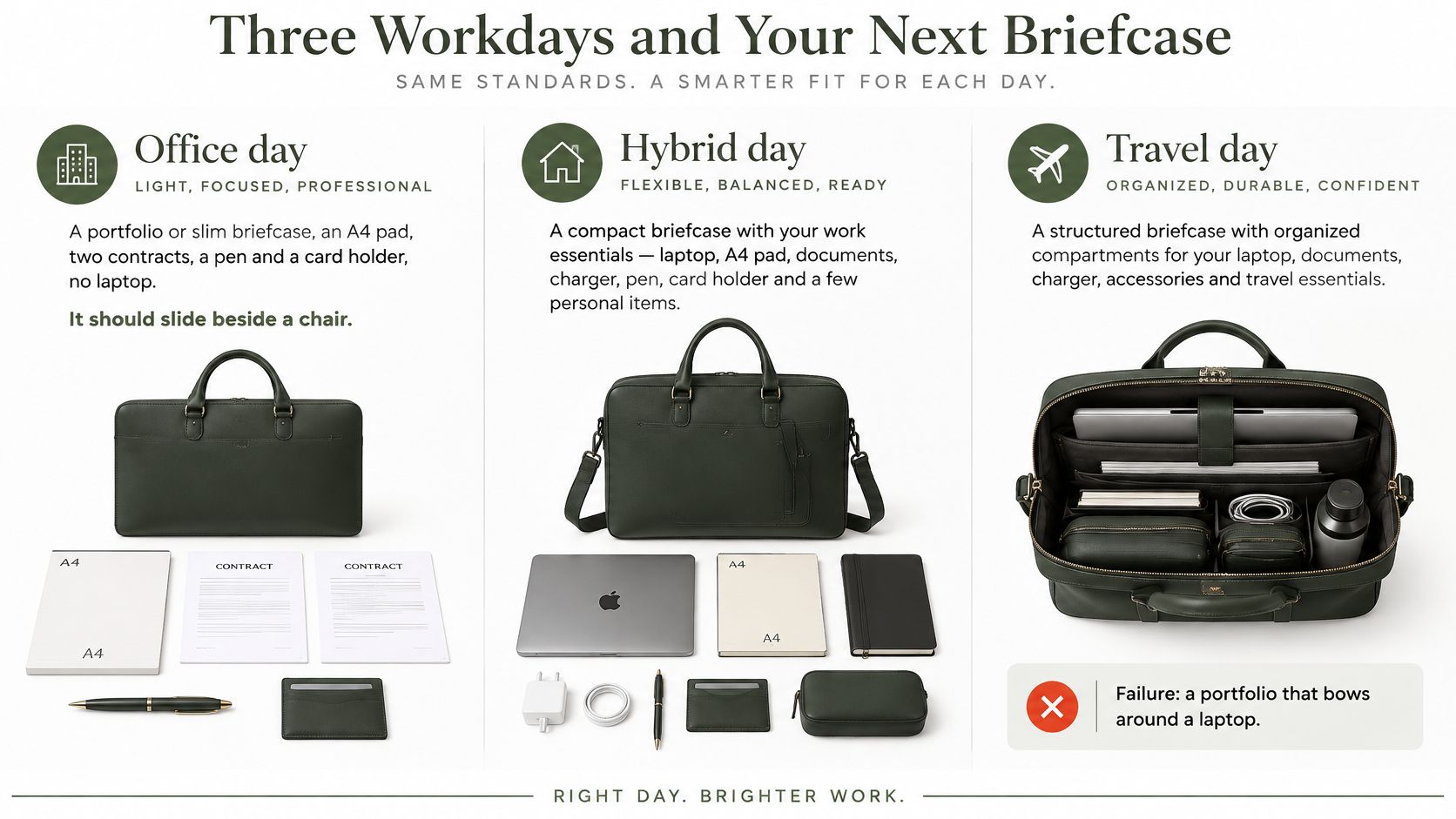
Say your office day needs an A4 pad, two contracts, a pen and a card holder, with no laptop. A portfolio or slim briefcase handles that cleanly. It should slide beside a chair, open flat on a desk, and avoid turning a short internal meeting into a luggage exercise.
The failure is predictable. Someone adds a laptop because there is nowhere else to put it, and the slim case bows around the chassis. The zipper takes the strain, paper corners bend, and the neat silhouette disappears. If laptop days are regular rather than occasional, that portfolio isn't undersized by accident. It's the wrong category.
Court or Client Day
Now the files must stay flat and presentable. A structured attaché or full briefcase carries the papers, a thin laptop in the back sleeve, one charger in a zip pocket, and a notebook without letting everything slide into a pile. A lock or covered closure adds control when documents are confidential, and a firm base keeps the case presentable beside a client table.
The failure here is travel geometry. The same rigid case that protects files may be too deep or too hard-cornered for the space under a flight seat. If the client day usually begins with a drive and a short walk, that trade-off may be worth it. If it starts at an airport, choose structure that still respects the personal-item space.
Travel Day
A travel day usually means the 15.6-inch laptop, a folder, a charger, and a cable pouch. A convertible briefcase lets you carry the load by handle at check-in, use the strap through the terminal, and keep the device near your back. Add a toiletry kit only if the packed bag still fits the personal-item box you are working to.
The failure is an oversized travel briefcase that seems clever for one trip and then travels half empty on office Tuesdays. Extra capacity invites extra junk, and extra junk becomes weight, sway, and clutter. Keep clothes and wash items in a separate duffel unless the trip is short enough that the briefcase remains disciplined.
Decision rule: Papers and a pen point to a portfolio. Flat files for clients point to a structured briefcase. Desk, train, and client site in one week point to a convertible.
If most days are papers and a pen, choose a leather portfolio or A4 padfolio. Grainmark Leather sells leather portfolios for men and A4 padfolio cases, including a handcrafted Classic A4 Leather Portfolio Case. If files must stay flat for clients, choose a structured full-grain or cowhide briefcase in black, brown, coffee, or burgundy. If your week mixes desk, train, and client site, choose a convertible briefcase whose sleeve matches your measured laptop.
We offer briefcases in full grain leather, Crazy Horse leather and cowhide leather, which lets you match the surface and structure to the job rather than treating one hide as the answer. On sale, The Trailblazer is €143.96 in Coffee for a balanced daily load, The Wildspur cowhide briefcase is €154.36 in Black, Coffee and Burgundy for court or travel days, and The Vantage is €200.76 in Black, Coffee and Burgundy when capacity matters.
Before paying, check the laptop sleeve against the size chart, confirm that the strap detaches and its hardware sits flat, and confirm the leather type you'll condition. Then load the bag once with your real kit. If it stands upright, closes without force, and keeps the laptop close to your body, you've matched the bag to your work instead of forcing your work into the bag.
Measure your laptop, choose the silhouette for your heaviest normal workday, and compare our full-grain, Crazy Horse, and cowhide briefcases alongside men's leather portfolios and A4 padfolio cases. Visit Grainmark Leather to check the sleeve dimensions, colors, and current sale models before you commit to your next daily carry.