
Pocket Pen Holder Guide: Types, Sizes and Leather Care
Your fountain pen slides against your keys every time you reach into your jacket pocket. By the end of the day, there's a fresh scratch across the cap. The pen still writes, but carrying it loose has started to look expensive.
A pocket pen holder gives the pen its own protective compartment in a pocket, bag or pouch. The useful question isn't which leather looks smartest. It's which holder fits your capped pen, stays secure during transport and lets you take a note without wrestling with the case.
Table of Contents
- Pocket Pen Holder Types and Where Each Fits
- Matching Holder Size to Fountain and Ballpoint Pens
- Leather Construction That Protects Your Pen
- Everyday Carry Rules for Pocket, Bag and Flight
- Choose a Holder by Testing Fit and Access
- Personalizing a Pocket Pen Holder as a Gift
Pocket Pen Holder Types and Where Each Fits
A holder should solve a specific carrying problem. A soft sleeve separates a pen from pocket contents; a rigid case adds resistance to crushing. Buying more protection than you need can leave you with something too bulky or slow to use.
The underlying need is older than today's everyday-carry accessories. Wikipedia's fountain-pen history describes the development of refillable, portable writing instruments, whose ink reservoirs and vulnerable nibs made controlled storage important. Modern holders still address that combination of portability and protection.
Pocket pen holder types compared
| Type | Protection | Access speed | Best for |
|---|---|---|---|
| Single sleeve | Good against scratches and light impact | Fast, one-handed with a suitable fit | One pen in a jacket or trouser pocket |
| Clip-style holder | Moderate, relies on pocket fabric | Fastest | Pen with a strong clip for quick notes |
| Zipper pouch | Good against scratches, closed on all sides | Slower, must unzip | Two or three pens in a briefcase |
| Multi-slot sleeve | Good, keeps pens apart | Moderate | Mixed ballpoint and fountain pens |
| Rigid case | Best against crushing and impact | Slowest | Valuable pens in carry-on bags |
A single sleeve suits a fountain pen carried in an inside jacket pocket. Leave enough cap exposed to grasp it without pulling on the clip. A sleeve that disappears deep into the pocket may protect well but make every retrieval awkward.
A clip-style holder favors quick notes, such as signing a delivery slip while standing. It anchors the instrument rather than surrounding it with much structure. Don't expect pocket fabric and a retaining loop to resist a heavy object pressing against the pen.
A zipper pouch works for a hypothetical briefcase load of three pens plus spare cartridges. Its weakness is internal contact: a shared compartment doesn't automatically stop pens rubbing together. For delicate finishes, choose dividers or individual inner sleeves; the guide to leather pencil cases helps distinguish pouch layouts.
A multi-slot sleeve makes sense for a fountain pen and a backup ballpoint. Separate channels prevent contact, but check that the divider continues far enough down the case. A rigid case earns its extra bulk when a valuable pen travels beneath headphones, chargers or other luggage contents in a carry-on.
What the clip does and doesn't do
The clip secures the pen's position. The holder protects it from scratches, pressure and keys, with the degree of protection determined by its construction.
Practical rule: If the clip holds securely and nothing hard shares the pocket, the clip may be enough. If the pen is valuable or shares space with metal, add a holder.
Reject a holder if the pen slides out unaided during ordinary carry, the clip scrapes the lining, or retrieval requires so much handling that you stop using it. More enclosure generally means slower access, especially when closures and bag compartments are involved.
Choose the row that matches your routine. A daily pen points toward a sleeve; mixed pens and accessories point toward a pouch.
Matching Holder Size to Fountain and Ballpoint Pens
A fountain pen that fits a shirt pocket capped may still bind at the cap lip or clip when you slide it into a holder. Size the holder to the pen's full capped length and widest point, not its writing length or a label such as “standard.”
Measure the actual instrument. The barrel, cap band, clip attachment, or finial may be wider or longer than the main body, and each can affect fit.
Pen sizes and matching holder dimensions
Use these approximate dimensions as starting points for comparison, then check the pen and holder themselves.
| Pen format | Capped length | Barrel diameter | Holder internal length | Holder internal diameter |
|---|---|---|---|---|
| Compact pocket fountain pen | About 105 mm | 10–11 mm for a slim example | 110–120 mm | 12–13 mm |
| Full-size fountain pen | 132–151 mm | Measure the actual pen | About 155 mm | 15–17 mm |
| Oversized piston-filled fountain pen | Measure the actual pen | 14.5–18.5 mm | About 155 mm | 19–21 mm |
These dimensions are typical ranges, not a fit guarantee. A wider oversized pen needs a holder opening wider than its widest point, while a compact pen may still have a broad cap or clip. Allow enough clearance for easy insertion without letting the pen shift excessively.
Measure before ordering
- Check the widest point. Use calipers with light pressure, or place the pen beside a ruler. Measure the barrel, cap and clip assembly, not just the grip.
- Measure the complete capped length from end to end. Include a projecting finial or clip, and consider how much of the pen must remain exposed for your fingers.
- Allow clearance. The pen should slide in without squeezing the leather around it. A gusset accommodates shape, but it does not make a narrow opening suitable for a wide cap.
- Compare your measurements with the holder's usable internal dimensions. Exterior measurements include leather, lining and seams; a closure may also reduce usable depth.
A close fit limits sideways movement. A compressed fit makes removal harder and can press against a cap band, decorative trim or exposed filling knob.
For a ballpoint, measure it with the tip retracted. Check that the holder does not press the push button and extend the point inside the lining. If the holder will also store a fountain pen on a desk, follow these fountain-pen storage guidelines.
Test the fit with the retention released and your hand ready to catch the pen. It should slide out under control, without catching on a seam or needing a twist.
Leather Construction That Protects Your Pen
Full-grain leather retains the outer grain layer. That's a useful starting point for a flexible sleeve, but the lining, finish and seam placement still determine what touches your pen.
Corrected-grain leather has its surface altered, often with an applied finish. Bonded leather uses leather fibers held together with a binder. Neither label tells you everything about durability, and full-grain leather isn't immune to cracking if it dries out or carries an unsuitable coating.
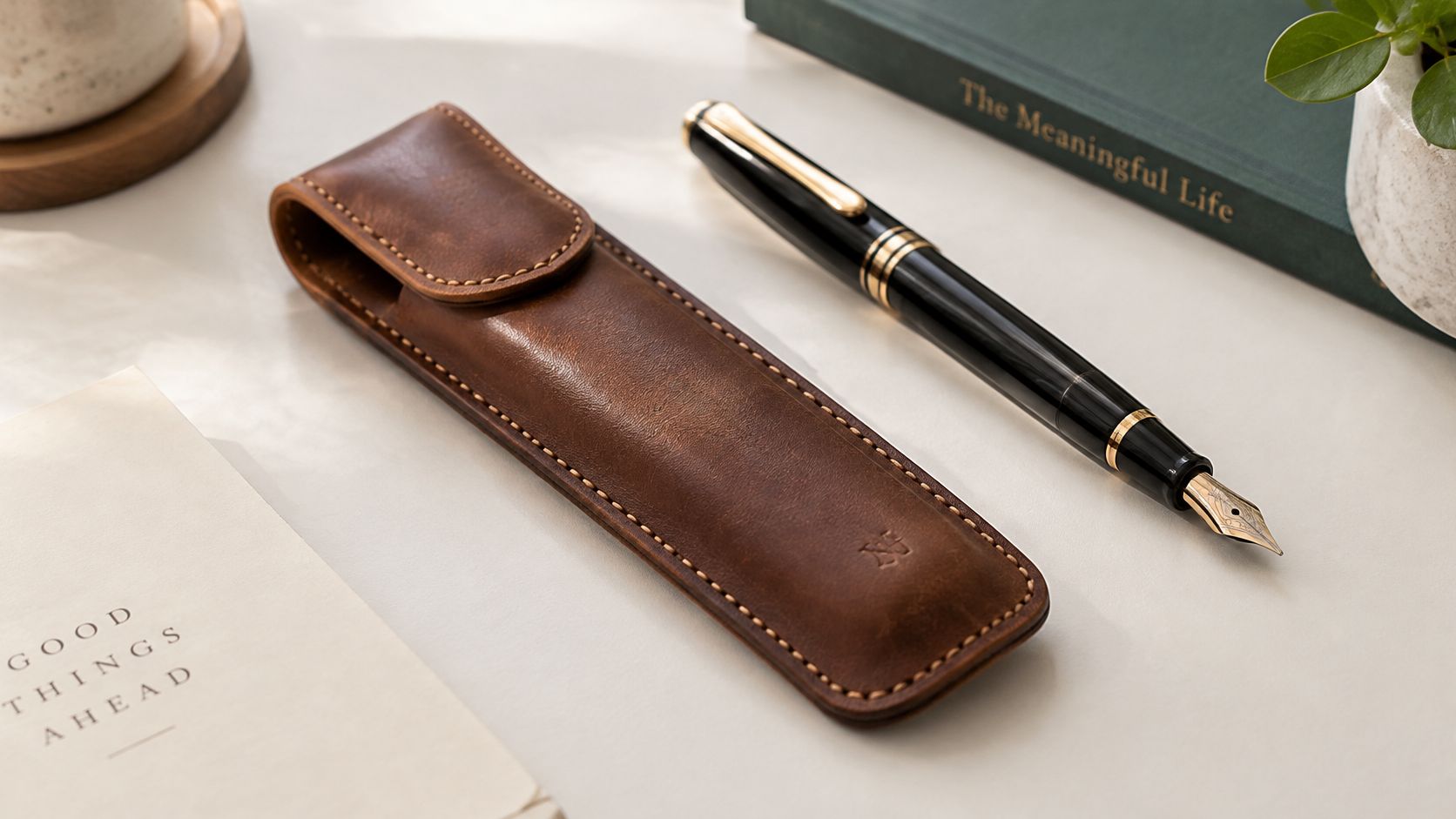
Look beyond the exterior color when comparing a sleeve like this with your own pen.
What natural wear should look like
Crazy horse leather is a useful example of a waxed, pull-up finish, commonly applied to full-grain cowhide. It isn't horsehide, and the name alone doesn't certify a particular hide grade or finishing recipe. Check the product's material description rather than assuming every version is identical.
When this leather bends, wax movement produces lighter and darker areas. Around a pen clip, that can create a visible crease and changing tone rather than a uniform surface. Distinguish that cosmetic change from a coating peeling away or a seam opening.
Wax-rich leather can also transfer color or residue. Before putting a pale resin or lacquered pen inside an unlined sleeve, rub an inconspicuous area with a clean white cloth and inspect for transfer. A soft lining provides a useful barrier, but loose grit can still scratch a polished barrel.
Inspect the inside before the outside
Cotton or microfiber lining should feel smooth, without exposed adhesive, coarse edges or hardened seams. Run a fingertip along the closed end, where the pen rests. A soft-looking opening doesn't help if the bottom contains a rough folded seam.
Stitching matters most where insertion spreads the mouth and where the clip bears against the edge. Look for even tension, secured ends and no loose loops that could catch the clip. Thicker leather adds structure, but it also makes a loaded holder more noticeable in a trouser pocket.
Use this product-page checklist:
- Grain type: Look for a specific material description, not leather alone.
- Lining: Check what contacts the barrel and whether the bottom is finished.
- Stitching: Inspect the mouth, corners and closed end in close-up photographs.
- Closure: Make sure snaps, magnets and zipper teeth can't scrape the pen.
For care, remove the pen, brush out debris and wipe the exterior with a barely damp cloth. Let it dry away from direct heat; apply conditioner sparingly and test for darkening first. The leather-conditioning guide explains the care sequence, but don't apply conditioner to the lining or leave residue where the pen rests.
Everyday Carry Rules for Pocket, Bag and Flight
More padding won't fix a leaking fountain pen. Padding reduces impact and surface contact; it doesn't control the ink reservoir, secure a loose cap or guarantee containment.
Movement can drive ink into the cap, while body warmth can expand the air inside a partly filled reservoir. During flight, reduced cabin pressure creates another reason to manage orientation. Cartier's writing-instrument care advice recommends keeping fountain pens capped and nib-up during air travel, alongside careful handling and appropriate stationary storage.
Carry orientation by location and pen type
| Carry location | Fountain pen | Rollerball or gel | Ballpoint |
|---|---|---|---|
| Jacket pocket | Capped in a snug sleeve, nib-up with clip secure | Clip is enough for short carry in a clear pocket; cap or retract tip | Clip only, if the clip is firm and tip retracted |
| Trouser pocket | Capped in a sleeve with a separate leak barrier when needed, away from keys | Sleeve reduces scratches; cap or retract tip | Sleeve optional; tip retracted |
| Briefcase | Capped, nib-up in a secured pouch during transport | Pouch keeps pens apart; cap or retract tip | Loose in a pouch is acceptable for a durable finish |
| Carry-on flight | Capped, nib-up in a holder with a sealed secondary barrier | Capped or retracted in a pouch; check manufacturer's flight advice | Any holder that stops rolling and accidental activation |
A jacket pocket usually offers a straighter carrying position than a trouser pocket. Secure the sleeve so it doesn't rotate when you sit or lean forward. If the pen's weight drags the pocket out of shape, move it to a bag rather than tightening the clip against the fabric.
Trouser pockets expose pens to bending and pressure when you sit. A sealed secondary pouch can contain an ink escape, but it won't resist crushing. Don't assume a leather sleeve or ordinary zipper pouch is leakproof.
For briefcase carry, anchor the pen pouch in an organizer compartment. A nominally upright pouch offers little benefit if it falls sideways beneath a laptop charger. When stationary, most fountain pens can rest horizontally, unless the manufacturer specifies otherwise.
Prepare the ink, not just the case
For a journey when you won't write, emptying and cleaning the fountain pen removes the ink-leak problem. If you need it ready to use, a properly filled reservoir leaves less trapped air than a partly depleted one, but don't overfill or leave ink around the section. Trip length matters less than whether you'll need the pen and can maintain its carrying position.
A closed leather case is protection from contact, not proof against escaping ink.
Before placing a loaded holder beside documents, clothing or electronics, test it over a washable surface. Insert the capped pen, close the holder, then gently tilt and move it through the positions it will encounter. Don't deliberately shake a fountain pen hard to test its case.
Inspect the cap, grip and lining afterward. If ink appears, stop and diagnose the pen rather than relying on absorbent lining to hide the leak.
For example, a fountain pen in a trouser pocket needs separation from keys and may warrant a sealed inner barrier. The same pen in a briefcase can ride upright in an anchored pouch without being squeezed against your leg. Use the guide to traveling with fountain pens when planning that setup.
Set the carry rule before buying the holder.
Choose a Holder by Testing Fit and Access
Choose the holder whose format, usable dimensions and lining match the pen you carry. Keep your measurements beside the product page, and treat missing internal dimensions as a reason to ask the seller, not as an invitation to guess.
Compatibility includes how the pen behaves during handling. JetPens' fountain-pen troubleshooting guide explains how movement can affect ink flow and how padded cases can soften accidental drops. That makes secure, comfortable handling more useful than padding alone.
Run a desk test, then a carry test
- Choose the format around the task. For meeting notes, prioritize a clear opening and direct grip on the cap. For bag transport, allow room for a closure and separate compartments.
- Check the stated internal dimensions against your pen, including the widest feature. Ask whether the quoted opening is measured flat or represents usable space around an inserted instrument.
- Test extraction force. Seat the holder as you'll carry it, release its closure or retaining clip, and withdraw the pen with your normal writing hand. A pocket sleeve that grips hard enough to demand another hand is too restrictive for quick access.
- Inspect the lining under a bright light. Look for trapped debris, exposed fasteners and seams that press against the finish.
- Load the complete set. For several pens, use individual slots or inner sleeves. Check whether inserting a broad fountain pen squeezes its slimmer neighbor or pulls the divider out of position.
A rattle during gentle movement suggests excess space, but silence doesn't prove a good fit. Soft leather may grip only the cap while leaving the barrel unsupported. Feel where the pressure sits and inspect the pen after removal.
Test it where you'll use it
Try the loaded holder in your jacket or bag before committing to it. Sit down, reach for your notebook and retrieve the pen without rearranging everything around it. Check whether a flap folds clear or falls back across the opening.
The most protective case isn't useful if you leave it behind because it interrupts ordinary work. A modest sleeve you use consistently is a better choice than a bulky enclosure that sends the pen back into a loose pocket.
Grainmark Leather's single pen sleeves and zipper pen bags are options alongside divided sleeves and rigid cases. Choose the size row that matches your measured pen, then confirm the individual product's internal fit before ordering.
Personalizing a Pocket Pen Holder as a Gift
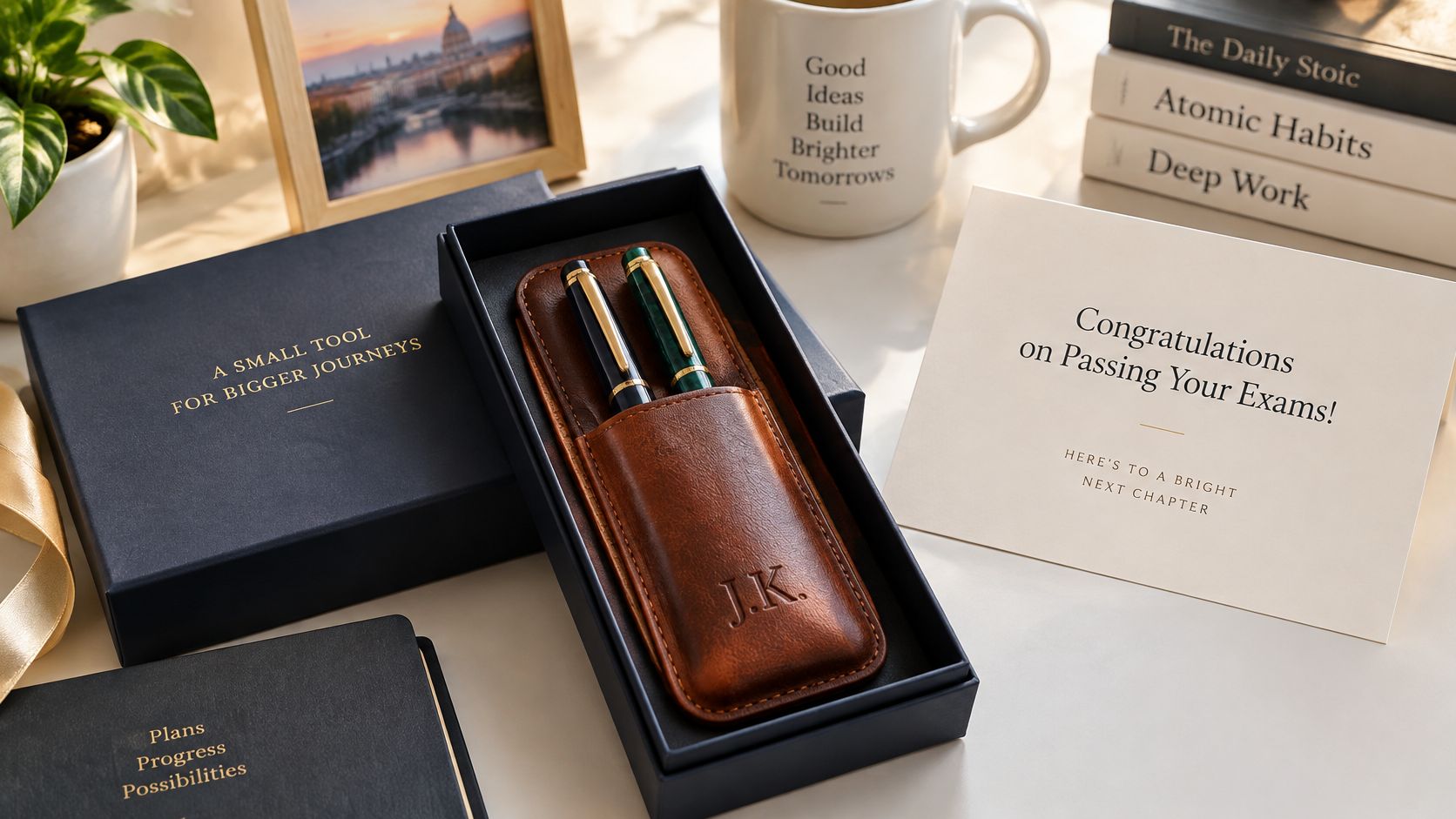
A colleague has passed a professional exam, or a fountain-pen collector wants a holder for a favorite daily pairing. A monogram can make the gift personal, but the useful part is still the fit. Initials won't rescue a sleeve that's too narrow.
Personalization may mean embossing, a monogram or another custom detail. It's available only where the store offers it on the particular product, so confirm the options, preview and ordering terms before paying.
A coordinated gift can be simple without sacrificing practical protection.
Size first, personal detail last
Start with the recipient's actual pen model and its capped measurements. If you can't measure it discreetly, ask for the model name or a photograph beside a ruler. Don't assume a collector's largest pen represents what they carry to work.
Next, choose the format around their routine. A single sleeve suits someone who carries a favorite instrument; a divided holder suits a coordinated set. A zipper pouch is more flexible for someone who also carries cartridges, an eraser or a mechanical pencil.
Only then choose the personal detail:
- Placement: Keep initials clear of the clip path, closure and stitching line.
- Visibility: Choose a position that remains visible with the holder loaded.
- Appearance: Match the lettering to the recipient's taste rather than filling every available surface.
A plain full-grain holder can develop attractive handling marks, while a thin, heavily coated surface may show wear less gracefully. That makes restrained decoration a sensible choice for frequent use, though construction still matters more than the leather label.
The guide to leather gifts for writers offers related gift ideas if you want to pair the holder with a journal or another writing accessory. Keep the pen holder itself focused on the recipient's habits, not presentation alone.
Before choosing the size to order, establish the pen model as well as its category: does the recipient use a fountain pen, a rollerball or a ballpoint?
Grainmark Leather offers single pen sleeves, zipper pen and pencil bags, and rigid pen boxes for different carrying routines. Visit Grainmark Leather to compare the formats, then check your pen's capped length and maximum width against the product's usable dimensions before ordering.