Canvas Duffle Bags for Men: How to Choose the Right One
You're packing for a Monday-to-Wednesday work trip, and your laptop, shirts, spare shoes and toiletries are spread across the bed. The canvas duffle you're considering looks tough enough, but will it fit everything without becoming miserable to carry through a station or airport?
The best canvas duffle bags for men balance usable space, comfortable carrying and sensible construction. Thick fabric and a waxed finish can help, but neither compensates for weak handle anchors, excessive empty weight or a zipper that lets rain reach your clothes.
Table of Contents
- Canvas Duffle Sizes by Trip Length
- Canvas Types Compared With Leather Accents and Nylon
- Construction Details That Decide Whether a Canvas Duffle Lasts
- Waxed Canvas Is Water-Resistant, Not Waterproof
- undefined
- undefined
- Choosing a Canvas Duffle for Your Commute or Travel
Canvas Duffle Sizes by Trip Length
Start with the load you carry, not the largest capacity your budget allows. For that work trip, the awkward items are usually the laptop sleeve and shoes, not the shirts. They determine whether the bag closes neatly or bulges into an uncomfortable shape.
Lay your essentials together before shopping. Include chargers, medication, your usual toiletries and anything you habitually carry home. A bag that fits only when you leave daily necessities behind is too small.
Choose a starting size, then prove the fit
The table below is an illustrative packing framework, not a standardized capacity rating or an airline allowance. Its litre ranges are hypothetical starting points for comparing bags with your own belongings.
Canvas duffle capacity by trip length
| Trip length | Illustrative capacity to test | What fits in the packing scenario | Usual carry |
|---|---|---|---|
| Overnight or two nights | 30-40 L | Change of clothes, toiletries, laptop sleeve | Carry-on candidate or gym-style handles |
| Three to four nights | 45-55 L | Clothing changes, shoes, toiletries, documents | Carry-on or check-in, check your airline's limits |
| Five nights or more | 60-70 L | Travel wardrobe, shoes, travel gear | Checked-bag candidate, empty weight matters |
| Gym or weekend sports | 25-35 L | Kit, shoes, towel, water bottle | Shoulder strap or top handles |
Litres describe volume, not how conveniently your belongings fit. A rigid base, tapered ends, thick lining and separate shoe compartment can all change the space available to your main load. In a hypothetical comparison, a structured 45 L duffle might accommodate your particular packing cubes less effectively than a soft 50 L bag.
Don't assume a dedicated compartment creates extra room. A shoe tunnel generally occupies space inside the bag, and an internal laptop sleeve can make a curved side panel less flexible. Open the bag fully and check whether you can place your largest items flat.
Sizing rule: Choose the smallest bag that fits your longest regular trip, with room for a spare change of clothes.
That rule avoids buying a cumbersome bag for a rare extended holiday. If you normally travel light, renting, borrowing or using separate checked luggage for an unusual trip may be more practical than carrying excess fabric every week.
Check the opening as well as the interior
A broad opening helps you load folded shirts without dragging them through a narrow zipper slot. End pockets are useful for small items, but bulky contents can distort the main compartment. Pack shoes in washable bags so you aren't forced to choose a duffle around a built-in shoe section.
For a broader comparison of layouts and travel priorities, use our men's travel duffle buying guide alongside your packing test.
Before choosing a row, answer these questions:
- Trip frequency: Are you buying for regular work travel or occasional weekends?
- Baggage preference: Do you want to avoid checking luggage, or is extra capacity more important?
- Laptop protection: Does the bag have suitable padding, or must your existing sleeve fit inside?
- Packing habits: Do you travel with compact toiletries and interchangeable clothing, or bulky equipment?
Choose the row closest to your ordinary load, then verify the actual dimensions. A capacity label alone can't settle the decision.
Canvas Types Compared With Leather Accents and Nylon
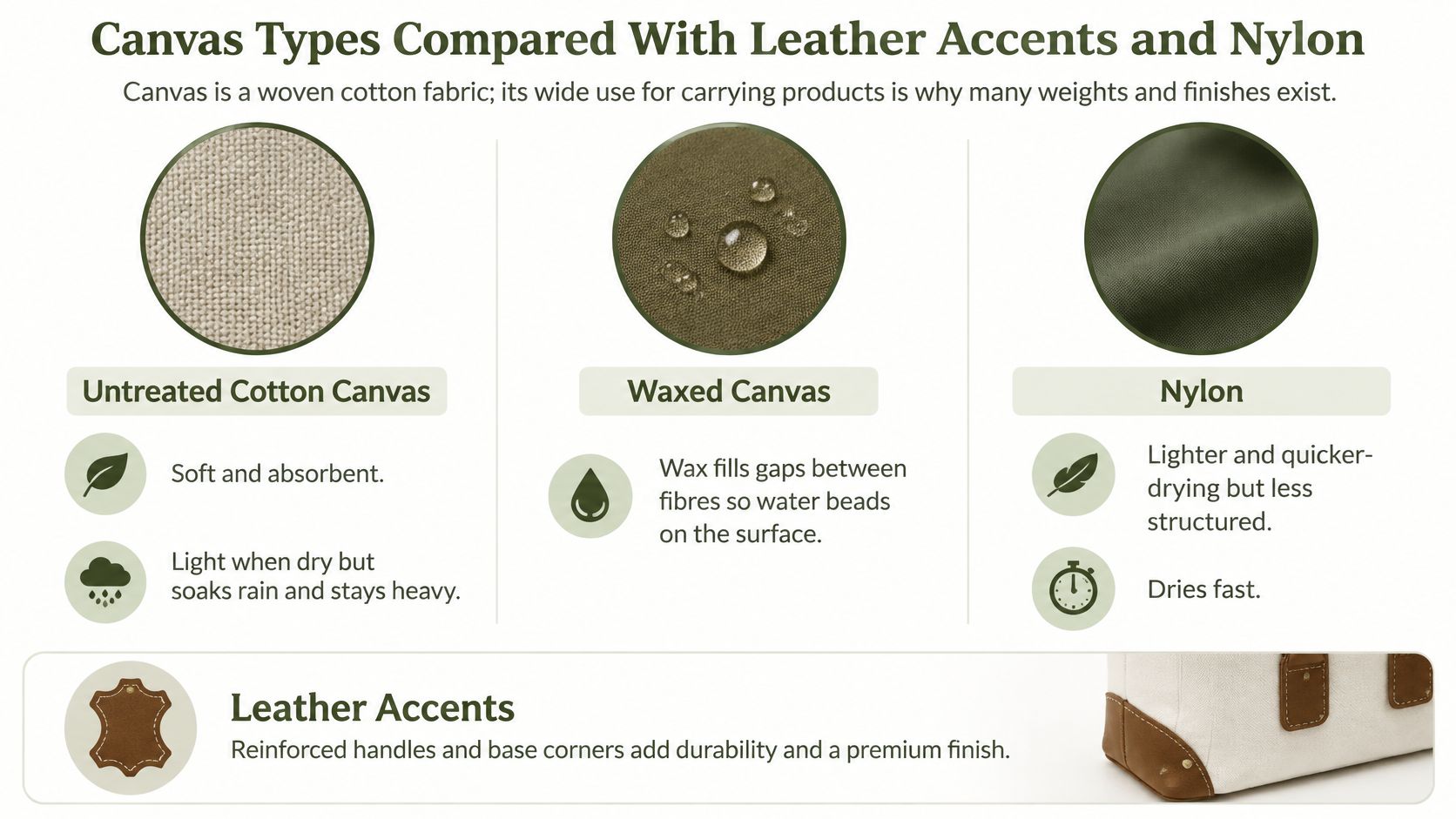
Cotton canvas is a woven fabric, not a single performance specification. Manufacturers can change the yarn, weave, finishing and reinforcement, which is why visually similar duffles can feel very different when lifted or folded.
Canvas is widely used for carrying products. Dataintelo's canvas market estimate places bags and backpacks at 18.6% of canvas-fabric applications in 2025, although that category covers more than travel duffles. For a buyer, the useful consequence is choice: inspect the particular fabric rather than treating canvas as a guarantee of quality.
Compare complete bags, not material names
Canvas and alternative materials compared
| Material | Rain performance | Weight and feel | Best for |
|---|---|---|---|
| Untreated cotton canvas | Absorbs water and can dry slowly | Soft and breathable, substantial in heavier constructions | Dry climates and light daily use |
| Waxed cotton canvas | Water-resistant surface, vulnerable openings remain | Usually firmer than untreated fabric | Commuting and ordinary rain |
| Canvas with leather trim | Shell treatment determines rain performance | Added structure and weight, especially with a leather base | Business and work travel |
| Ballistic nylon | Can offer strong water resistance, depending on coating and construction | Often lighter and more compact than heavyweight canvas | Frequent flying under weight limits |
Untreated canvas suits someone who likes a softer bag and mostly moves between sheltered locations. It folds and drapes more readily than heavily waxed cloth, but it isn't the material to choose solely for wet-weather protection.
Waxed canvas makes more sense when the commute includes exposed walks and occasional showers. The trade-off is a firmer feel and a finish you must maintain. Don't pay for treatment you won't need because it sounds more rugged.
Leather trim needs closer inspection than its appearance suggests. Handles and base corners can benefit from well-positioned leather, but decorative tabs don't necessarily strengthen the load path. A thin leather accent attached only to the outer shell isn't equivalent to a reinforced handle assembly.
If you prefer a more structured, leather-led travel bag, our full-grain leather duffel guide helps distinguish that purchase from choosing canvas with cosmetic trim.
Read the specification before choosing the colour
Look for the shell composition, finish and empty weight. If the listing says only premium canvas, ask what that means in practical terms: cotton or a blend, treated or untreated, lined or unlined.
Fabric weight can help you compare otherwise similar constructions, but it can't prove how long the finished bag will last. Heavier cloth adds material at wear points, yet it also adds weight everywhere else. A lighter shell with thoughtfully reinforced anchors may suit your travel better.
Use this short material filter:
- Dry-climate travel: Start with untreated canvas if you value softness and straightforward cleaning.
- Daily commuting: Consider waxed canvas when ordinary rain exposure is part of the route.
- Business trips: Choose leather accents for useful structure and comfortable handles, not decoration alone.
- Frequent flying: Compare nylon before committing to heavyweight canvas.
There's no need to choose the toughest-looking option. Choose the material whose disadvantages you can comfortably live with.
Construction Details That Decide Whether a Canvas Duffle Lasts
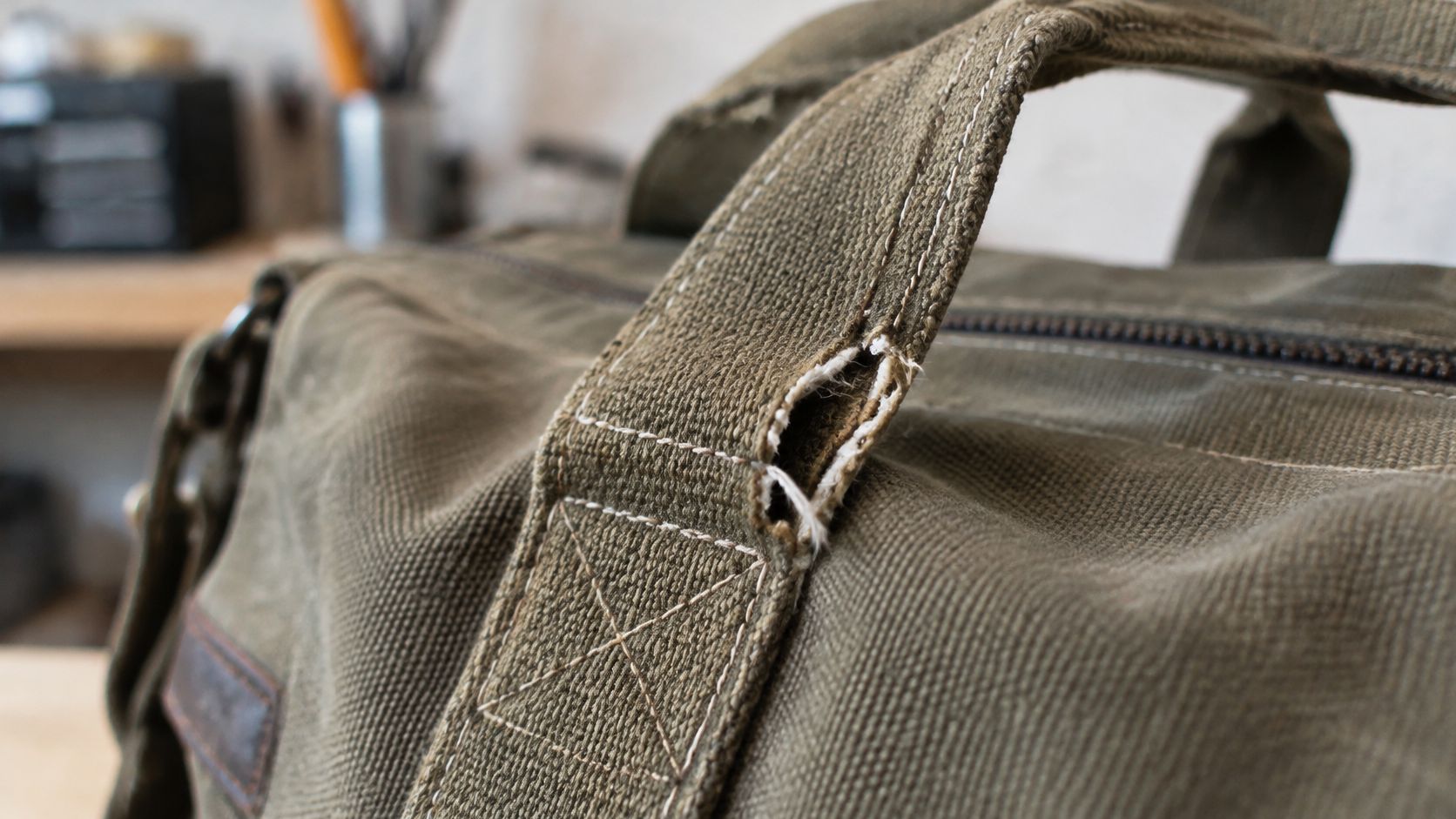
A handle can tear away while most of the canvas remains intact. In that failure, the weak point is the attachment, not necessarily the cloth.
Canvas strength is directional. A peer-reviewed study of finished cotton canvas measured tensile strength of 489.87 N in the warp and 350.57 N in the weft. Those measurements concern trouser fabric, not luggage certification, but they explain why panel orientation and reinforcement matter.
Makers should align stronger grain directions with major loads where practical. Buyers should look for box-X stitching or bar tacks, folded webbing, extra canvas layers and shoulder-strap anchors that spread force beyond the outer shell.
Inspect the load-bearing parts
- Pull the handles firmly. Watch for fabric puckering sharply around a small attachment patch.
- Follow the seams. Look for even stitches without skipped sections, loose loops or exposed, fraying edges.
- Trace the strap attachment. Confirm that reinforcement extends into several layers and inspect the base that supports the packed load.
Our canvas military backpack guide offers another useful format for comparing load-bearing construction. Prioritize these structural details over oversized buckles or decorative hardware.
Waxed Canvas Is Water-Resistant, Not Waterproof
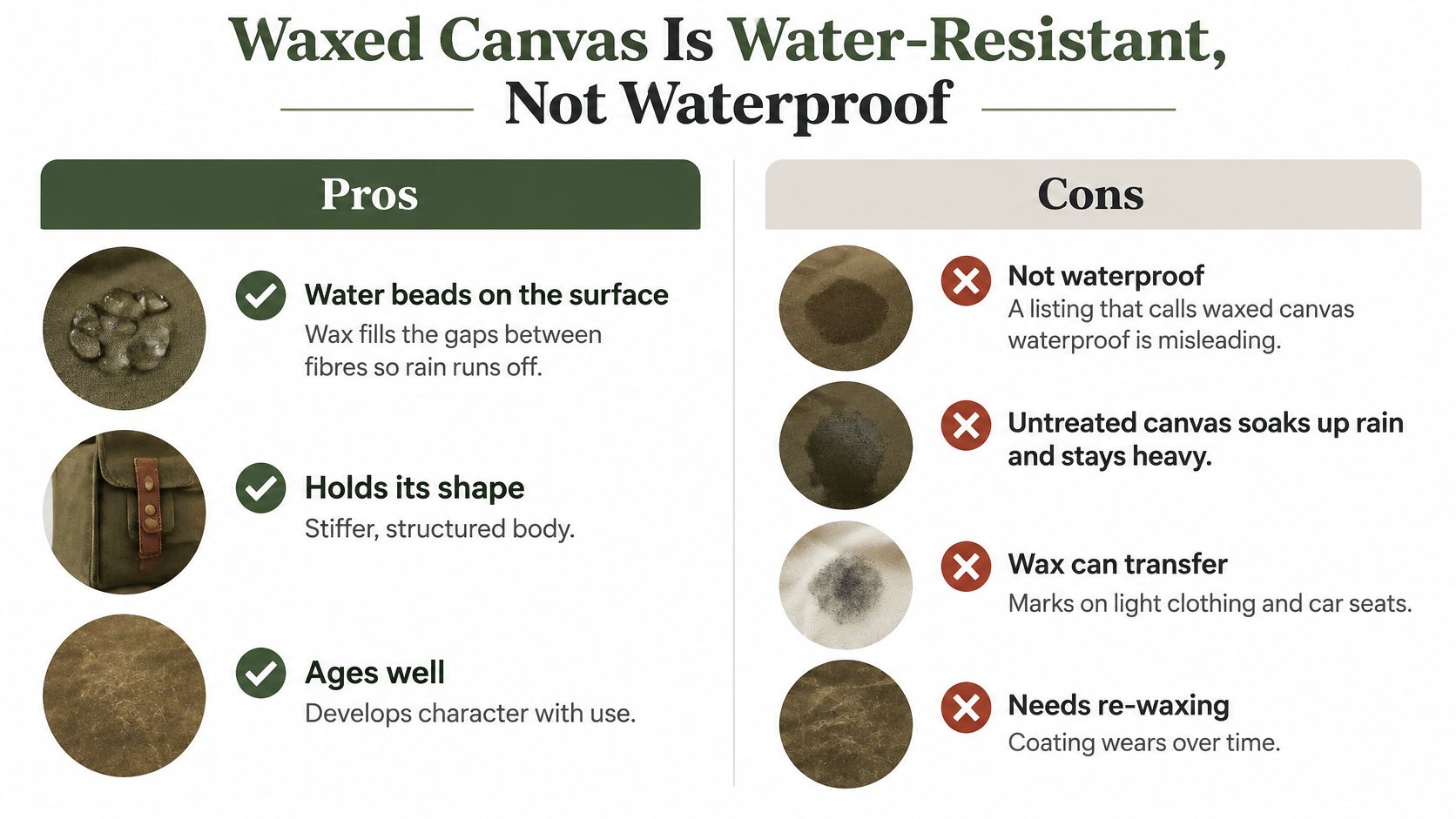
Calling waxed canvas waterproof overstates what the treatment does. Wax encourages surface beading, but it doesn't turn the entire duffle into a sealed container.
According to Hengsheng Textile's technical guide to waxed canvas, wax fills spaces between fibres and yarns, while needle holes and fold lines remain potential leakage points.
Match protection to exposure
Untreated canvas is reasonable for dry conditions. Waxed canvas suits brief rain exposure, but prolonged downpours and immersion call for separate protection around electronics, documents and spare clothing.
- Closure protection: Look for a storm flap that actually covers the zipper.
- Bottom construction: Inspect base seams and exposed attachment points.
- Internal separation: A lining keeps contents away from the shell, but isn't automatically waterproof.
A waxed fabric label isn't a weather guarantee for the finished bag.
Heavy waxing can increase stiffness; lighter treatment preserves more drape. Neither choice fixes an exposed zipper or poorly protected base.
When comparing canvas travel bags, judge the shell, closures and seams together. Keep valuables in a properly closed waterproof pouch whenever getting them wet would cause a serious problem.
undefined
Say you're preparing for a short business trip with a laptop, shirts, spare shoes, toiletries and a jacket. The empty duffle feels manageable in the shop. Once packed, its handles press into your fingers and the shoulder pad slides away from your shoulder.
That's the moment to reject the bag, even if everything fits. Capacity without comfortable carrying isn't useful capacity.
The Common Mom's carry-on duffel guide highlights the practical comparison between empty weight, dimensions, shoulder comfort and airline restrictions. Heavy canvas can be a poor trade when lightweight packing and frequent handling matter more than a substantial feel.
Run a realistic packing trial
Load the bag with your actual travel belongings rather than towels or loose clothing used to fill space. Put the laptop in its sleeve, pack the toiletries you normally take and include your chargers. Close every compartment without forcing the zipper.
Then work through this checklist:
- Weigh the empty bag. Use a luggage scale, or weigh yourself on a bathroom scale with and without the bag.
- Weigh the packed load. Include anything attached externally or placed in quick-access pockets.
- Measure the packed exterior. Check bulging pockets and protruding handles, not just the base panel.
- Check the operating airline's current rules. Use the allowance for your route, fare and baggage category.
- Carry it around. Walk, turn, climb stairs if available and lift it from floor level.
Don't assume a soft bag will compress when it contains rigid shoes, a laptop and tightly packed cubes. Its usable flexibility depends on what you put inside.
For an extended-trip scenario, add the clothing you'd realistically need, another pair of shoes if that's your habit, and a small day pack. Repeat the test rather than assuming the larger duffle will handle proportionally more weight comfortably.
Test each carrying method separately
Top handles are for short lifts: from a car boot, onto a luggage rack or across a hotel lobby. Check whether your fingers fit comfortably beneath them when the bag is full. Handles that look generous when empty can become awkward once the top panel rises.
A removable shoulder strap should have padding broad enough to distribute pressure without bunching. Slide the adjustment through its range and confirm that the pad stays where you need it. Check that clips rotate freely rather than twisting the strap.
Crossbody carry can keep your hands available, but a bulky duffle may strike your hip or interfere with walking. Try it with the coat you usually travel in, not just a lightweight shirt.
Buying test: The right duffle carries your real load comfortably and stays within your airline's rules when packed.
If you're deciding between otherwise suitable bags, subtract each empty weight from your baggage allowance. The remaining amount is what you can devote to belongings. You don't need to accept a heavy shell to get reinforced stress points.
Choose the bag that passes the trial, not the one that feels most impressive when empty.
undefined
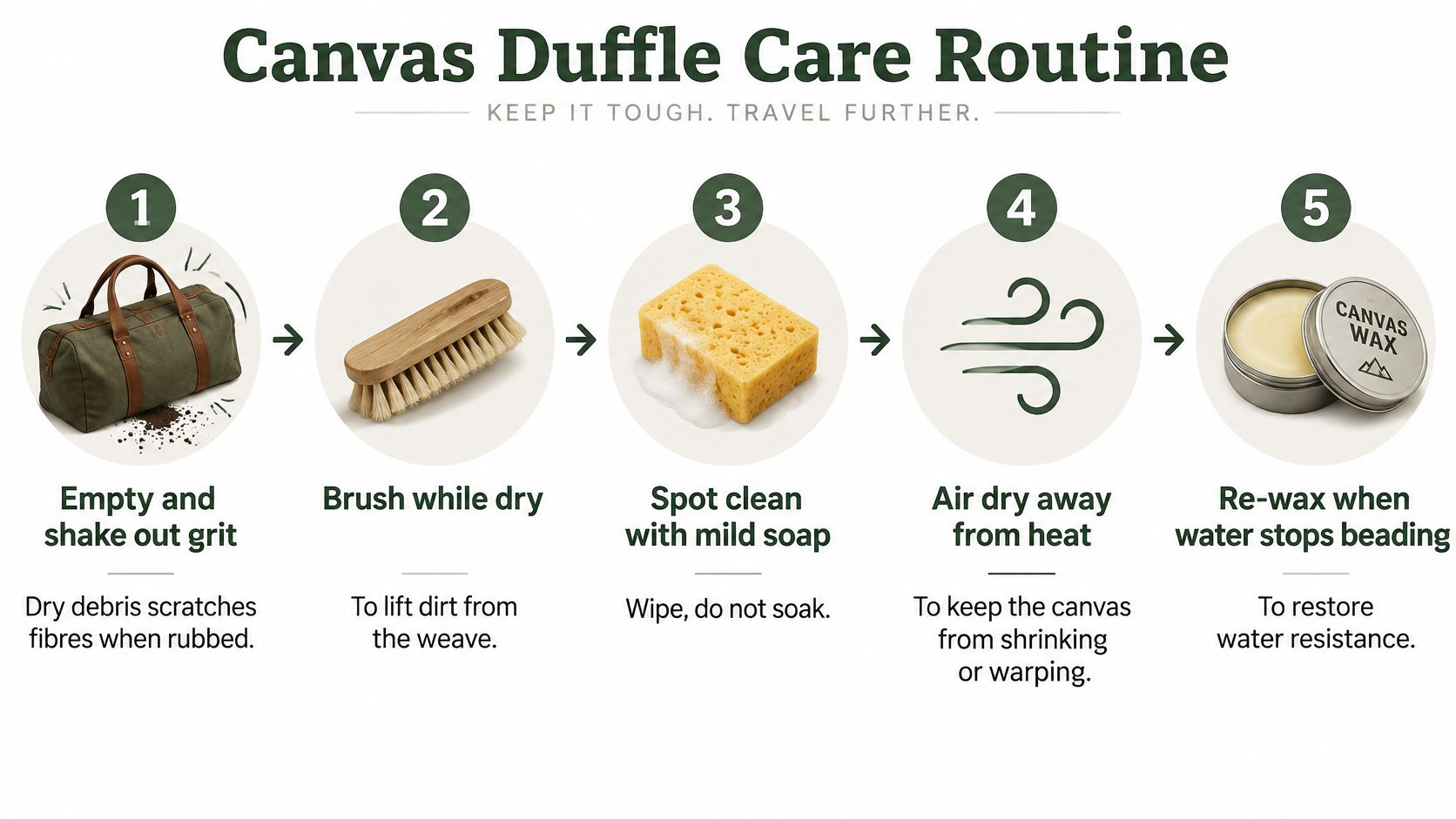
Clean a canvas duffle before dirt becomes embedded, but resist the urge to wash the whole bag whenever it develops a mark. Mixed construction complicates cleaning: cotton, wax, leather, lining and hardware may need different treatment.
The CHGR canvas weekender guide suggests re-waxing roughly every one to two years, alongside gentle cleaning and complete air-drying. Treat that as a maintenance prompt rather than a fixed deadline, since abrasion and exposure determine where the finish wears first.
Clean without saturating the construction
- Empty the bag completely. Open the pockets and shake out grit before touching the surface with a damp cloth. Rubbing loose debris into the weave makes cleaning harder.
- Use a soft, dry brush to lift dust and dried mud. Work gently around embroidery, leather edges and exposed stitching rather than catching them with stiff bristles.
- Test your cleaner on a concealed area. For untreated canvas, try a weak mild-soap solution on an inside seam and let it dry before proceeding. For waxed canvas, start with plain water and use a cleaner only if the maker permits it.
- Spot-clean with a damp cloth and cool water. Work from the edge of the mark inward to limit spreading. Keep moisture localized instead of wetting a large panel unnecessarily.
- Remove residue with a separate clean, damp cloth. Don't soak the bag to rinse it, especially where leather and canvas overlap.
- Air-dry with the main compartment open. Stuff loosely with clean, unprinted paper to support the shape, replacing it if damp. Keep the bag away from radiators, tumble dryers and direct heat.
- Restore wax only where the finish needs it. Use a compatible fabric wax in a thin layer, warming it gently only as directed by the wax maker. Let it settle and cure before packing the bag or placing it against clothing.
- Treat leather trim separately. Apply a small amount of suitable conditioner to a cloth, test it discreetly and keep it off the canvas. Buff away excess rather than leaving a greasy coating on handles or base panels.
Avoid the fixes that create new problems
Machine washing can disturb the finish and expose leather components to more water than they should receive. Aggressive detergent isn't a shortcut, and high heat isn't a sensible way to hurry a damp bag back into service.
Over-waxing is another common mistake. A thick coat can leave the surface tacky and unnecessarily stiff without solving leaks at the zipper or seams. Apply less, inspect the result and build coverage only where required.
Store the bag fully dry with pockets open and the shoulder strap relaxed. Don't seal a damp duffle in a cupboard or plastic storage cover.
Care tasks and intervals for canvas duffle bags
| Task | How often | Method | Avoid |
|---|---|---|---|
| Brush off dirt | After each trip or muddy use | Soft brush on dry canvas | Wet scrubbing grit into the weave |
| Spot clean | When marks appear | Suitable mild cleaner, damp cloth, cool water | Machine washing unless the maker permits it |
| Re-wax waxed canvas | When high-contact areas lose repellency | Thin coat of compatible wax, then cure | Heavy coats that stiffen the fabric |
| Dry the bag | After any wetting | Air-dry fully, loosely stuffed | Dryers, radiators, direct heat |
| Condition leather trim | When the leather needs conditioning | Small amount on handles and base | Oils left on the canvas |
Choosing a Canvas Duffle for Your Commute or Travel
Choose for the journey you repeat most often. A bag that works for an occasional holiday may be unnecessarily bulky for daily office use.
For commuting
- Accessible essentials: Keep your laptop, keys and travel pass reachable without unpacking clothes.
- Manageable carrying: Choose a comfortable strap and a load you can carry without repeatedly changing shoulders.
- Appropriate protection: Match the finish and closure to the exposed parts of your route.
If clothing takes up little space, compare canvas laptop bags before committing to a duffle.
For travel
- Verified fit: Confirm packed dimensions and weight against your booking.
- Sound attachments: Inspect handle anchors, strap clips and seam quality.
- Practical maintenance: Choose a finish you're willing to clean and maintain.
For shared airport journeys, the Airport Vans NYC group transfer guide is a useful planning resource when coordinating passengers and luggage.
If you decide leather better suits your routine, our Cowhide Leather Duffel Bag comes in Brown and Black, the Mason in Coffee, and the full-grain Fernwood in Brown and Coffee.
Before buying, confirm the dimensions, test your packed load and inspect the attachments. Choose the colour only after the bag passes those checks.
Grainmark Leather offers leather duffle bags, work bags, toiletry bags and organizers for daily carry and travel. Visit Grainmark Leather to compare a leather alternative with your canvas shortlist, using your packing load, carrying needs and preferred level of upkeep to guide the choice.